Market Size and Growth Trajectory
The hybrid inverter market has moved from a niche product category to a mainstream procurement line in under a decade. Synthesis of published analyst estimates puts the global hybrid inverter market at roughly USD 4–5 billion in 2023, expanding at a 14–18% compound annual growth rate through 2030 — roughly double the growth rate forecast for conventional string inverters over the same period. The category's share of residential inverter revenue is already above 50% in mature storage markets such as Germany and Australia, where a hybrid unit is now the default specification rather than an upgrade.
The demand pull comes from storage, not from PV. According to BloombergNEF, global annual energy storage installations are expected to roughly triple between 2024 and 2030, and the residential and commercial segments — precisely the segments hybrid inverters serve — account for a meaningful and growing share of that pipeline. The IEA's Renewables 2024 report projects approximately 5,500 GW of new renewable capacity between 2024 and 2030, with solar PV accounting for around 80%; every one of those distributed PV systems is a potential hybrid inverter site.
Shipment data reinforces the trend. Global inverter shipments reached roughly 385 GW in 2023 according to BloombergNEF tracking, and while utility-scale string and central inverters dominate that figure by volume, the hybrid segment is where average selling prices, gross margins and product differentiation are highest. In residential and light-commercial channels, hybrid units increasingly displace the classic two-box architecture of a PV-only inverter paired with a separate battery inverter or AC-coupled retrofit.
From String-Only to Hybrid: The Economics
The core economic argument for hybrid architecture is conversion efficiency. A hybrid inverter charges and discharges a DC-coupled battery through a single conversion stage, typically achieving 94–96% round-trip efficiency with a high-voltage battery, compared with 88–92% for an AC-coupled retrofit, where energy is converted DC-to-AC and back again. Over a 10-year system life in a self-consumption-heavy market, that difference represents several hundred kilowatt-hours of otherwise curtailed or purchased energy per household.
Backup power has become equally decisive. Modern hybrid platforms offer an emergency power supply (EPS) output with transfer times of 10–20 ms, fast enough to keep computers, routers and modern heat pumps running through grid faults. In markets that have shifted from net metering to net billing — California under NEM 3.0, parts of Australia, and a growing list of European utilities — the value of a kilowatt-hour consumed on-site is two to three times the export tariff, which makes storage dispatch, not export maximisation, the design objective.
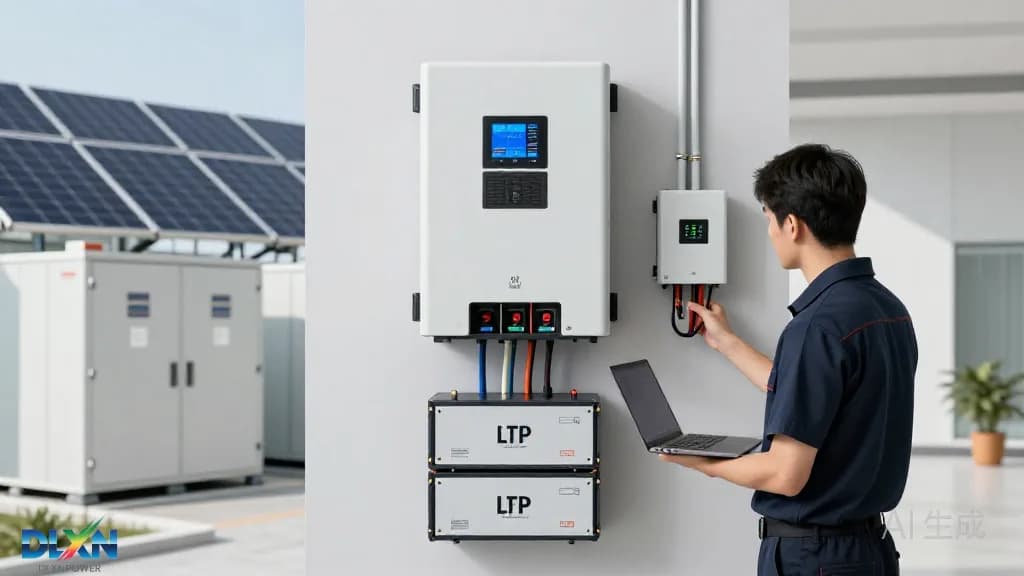
Installer economics close the loop. A single hybrid SKU replaces two devices, one set of permits, one commissioning interface and one firmware . That reduces truck rolls, wiring labour and warranty administration, and it allows a single app to configure a full system — PV array, storage, backup circuits and monitoring — in a fraction of the time a dual-inverter design requires. For technical detail on how these platforms integrate with modern module and battery specifications, see [hybrid inverter platforms](/tech/inverters).
Regional Dynamics: Europe, North America and Asia-Pacific
Europe remains the most mature hybrid market. Germany's residential storage fleet passed 1.5 million installed systems and more than 15 GWh of cumulative capacity in 2024, according to figures tracked by the German solar industry association BSW-Solar, and hybrid units now account for the clear majority of new residential inverter sales. The UK removed VAT on standalone battery storage in February 2024, removing a long-standing cost penalty for retrofit storage. Italy's post-Superbonus reset has slowed volume but pushed the market toward higher-quality, self-consumption-driven designs.
North America is growing faster from a smaller base. The Inflation Reduction Act's 30% investment tax credit applies to standalone storage, decoupling the battery decision from the PV decision and increasing demand for inverters that can manage both. In California, Wood Mackenzie and industry surveys indicate that storage attach rates on new residential PV systems have moved above 50% since NEM 3.0 took effect. UL 1741 SB certification is now effectively mandatory for interconnection in most US jurisdictions, and it has become a filtering criterion for product selection.
Asia-Pacific is the volume engine. Australia's SunWiz data shows battery attach rates on new rooftop PV systems climbing toward 30%, driven by state rebate programs and feed-in tariff declines. China's manufacturers have scaled hybrid production aggressively, and India's PM Surya Ghar program, combined with tightening net-metering rules in several states, is pushing residential buyers toward storage-ready designs. Pairing hybrid inverters with appropriately sized arrays — see [solar panels](/products/solar-panels) — is now standard practice in these markets.
Technical Evolution: High-Voltage Batteries and Grid-Forming Control
The most significant technical shift in the segment is the migration from 48 V low-voltage battery architectures to 200–600 V high-voltage systems. Higher bus voltage reduces current for a given power level, cutting resistive losses and allowing thinner cabling and cheaper power electronics. It also raises round-trip efficiency, with leading high-voltage hybrid platforms achieving 96–98% peak conversion efficiency and European weighted efficiency of 96–97.5% under EN 50530 test conditions.
Capability envelopes have expanded in parallel. Current residential hybrids cover 3–15 kW with two to four MPPT channels, string currents of 16–20 A, DC/AC oversizing ratios of 1.5:1 and peak output of up to 200% of rated power for short durations to handle motor starts. Commercial three-phase units now span 30–125 kW. Battery charge and discharge currents of 100–200 A are common, and most platforms offer both AC- and DC-coupled inputs so that a system can be expanded incrementally.
Regulatory capability is the new battleground. IEEE 1547-2018 and UL 1741 SB in the United States, VDE-AR-N 4105 and VDE-AR-N 4110 in Germany, EN 50549-1/-2 across the EU, and AS/NZS 4777.2:2020 in Australia all require advanced grid support functions: volt-watt and volt-var curves, frequency-watt response, ride-through, and export limiting. Add grid-forming capability and the hybrid inverter becomes a dispatchable asset rather than a passive producer. Storage sizing and chemistry choices interact directly with these functions — see [lithium battery](/products/lithium-battery) options.
Supply Chain, Pricing and the Competitive
Pricing has fallen sharply. European residential hybrid inverter prices declined roughly 15–20% between early 2023 and mid-2024, with entry-level 5–6 kW units compressing toward the €0.10–0.13/W range as Chinese manufacturers increased export volumes and European distributors cleared inventory. Gross margins that once exceeded 30% in the residential hybrid segment have narrowed significantly, and several European and US vendors have responded by shifting toward software, monitoring subscriptions and service revenue.
Competitive structure is consolidating around a handful of scale players. Huawei and Sungrow lead global inverter shipments by volume according to BloombergNEF and S&P Global Commodity Insights rankings, while GoodWe, Growatt, Deye and SolaX hold strong positions in the residential hybrid segment. In Europe and North America, SMA, Fronius, SolarEdge, Enphase and Victron compete on grid-support features, installer strength and service depth rather than on headline price per watt.
Supply-chain risk has also re-shaped sourcing. Installers increasingly demand dual-sourcing of inverters, documented cybersecurity compliance and guaranteed firmware support windows of 10 years or more. Battery cell supply — dominated by LFP chemistry for stationary applications — remains the largest cost and availability variable, and inverters that support multiple battery vendors command a premium because they preserve optionality. Broader system architecture implications are covered under [battery storage](/tech/battery-storage).
Standards, Virtual Power Plants and the Road to 2030
The next phase of growth will be defined by aggregation. Virtual power plant programs in Australia, the United States and parts of Europe now pay residential storage owners for coordinated dispatch, and FERC Order 2222 in the US opens wholesale markets to distributed energy resources. Inverters with certified, low-latency communication interfaces — SunSpec Modbus, OpenADR, IEEE 2030.5 — are positioned to capture that revenue, while unconnected units are not.
Cybersecurity is becoming a hard gate. The UK's Product Security and Telecommunications Infrastructure Act took effect in 2024, and IEC 62443 alignment is increasingly specified in utility interconnection agreements. For inverter vendors, this means secure boot, signed firmware, encrypted telemetry and documented vulnerability disclosure processes — engineering overhead that favours larger manufacturers and accelerates consolidation.
Looking to 2030, three trajectories appear : the hybrid inverter becomes the residential energy hub managing PV, storage, EV charging and flexible loads; bidirectional and vehicle-to-home functionality converges with the inverter itself; and grid-forming capability becomes a procurement requirement rather than a differentiator. Deployment examples across residential and commercial sites are documented in our [projects](/projects) portfolio. For installers and asset owners, the strategic implication is straightforward — specify for interoperability and standards compliance today, because the hardware will outlive the tariff structure it was bought under.