The 2025 Off-Grid Energy Storage
The global market for energy storage has entered a phase of hyper-growth. According to BloombergNEF, global annual energy storage installations are projected to more than triple between 2023 and 2030, with battery pack prices falling from $149/kWh in 2023 to $115/kWh in 2024 — a record low that now makes off-grid systems economically viable far beyond wealthy hobbyists. For the first time, residential off-grid and solar-plus-storage systems have achieved a levelized cost of electricity competitive with diesel in remote locations, which is the key catalyst behind a market once limited to mountain cabins and ecological research stations.
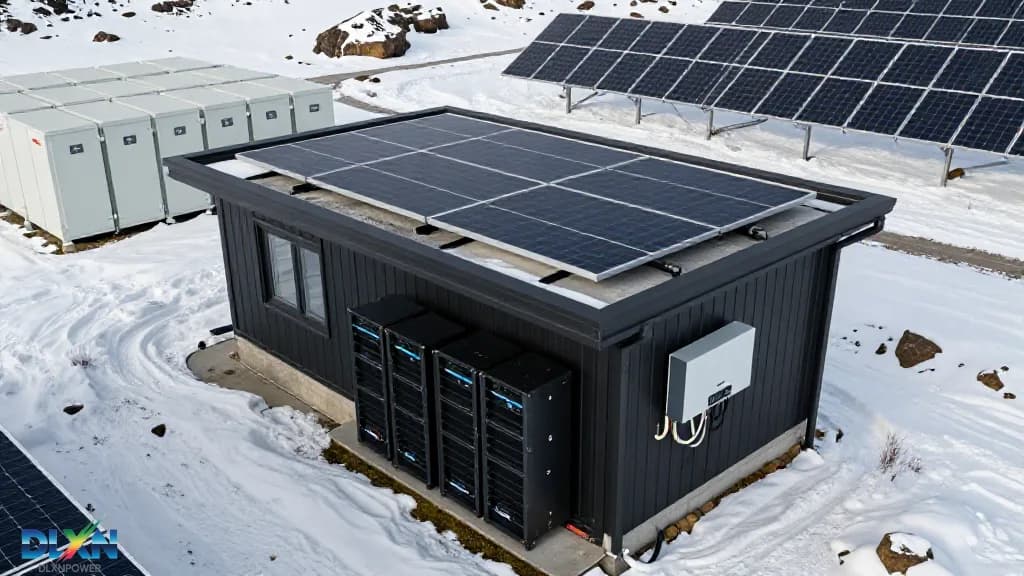
Much of this expansion is battery-driven, not photovoltaic-driven. The International Energy Agency’s 2024 World Energy Outlook reports that decentralized solar PV continues to be the fastest-growing source of electricity in Africa and other grid-poor regions, where it now powers millions of off-grid systems. A typical modern installation couples a 5–10 kWp PV array with a 10–20 kWh lithium battery bank, managed by hybrid inverters capable of islanding from the grid . As equipment enclosure designs advance, even cold-climate telecom towers and mining camps — historically reliant on generators — are converting to photovoltaic generation backed by lithium storage controlled by sophisticated energy management systems.
One hardware trend is cellular lithium iron phosphate modules. A 16-cell 48V battery bank, for example, now comes in server-rack format, is floor-stackable, and communicates with the inverter over CAN (the controller area network bus). In 2025, mainstream cabinets such as the [DLXN lithium battery series](/products/lithium-battery) deliver 10.24 kWh per module and are designed to be paralleled indefinitely, scaling from a 5 kWh emergency backup to a 200 kWh off-grid plantation. This stackability has removed the sizing anxiety that previously plagued off-grid homeowners.
LFP Cell Chemistry: Higher Capacity, Longer Lifespan
The dominant chemistry for stationary storage in 2025 is lithium iron phosphate (LFP), a compact transition that occurred over the past three years. According to research from the International Energy Agency, LFP captured roughly 70% of the storage battery market in 2024, displacing nickel-manganese-cobalt (NMC). The shift is welcome in the off-grid sector because LFP offers two decisive benefits: thermal stability (thermal runaway onset above 200°C versus roughly 150°C for NMC) and exceptional cycle longevity. Modern LFP prismatic cells take 6,000–10,000 cycles to 80% state-of-health at 80–100% depth-of-discharge, giving a daily-cycled off-grid battery a 15–20-year operating lifetime.
At the cell level, 2025 has brought a new generation of large-format prismatic cells. Leading Chinese manufacturers EVE, CATL and BYD are shipping 314Ah (approximately 1 kWh) cells, up from the 280Ah (0.9 kWh) standard of 2023. These larger cells reduce the number of weld points and connection lugs — a reliability weak point in remote installations that are serviced only once or twice yearly — while increasing energy density to roughly 180–200 Wh/kg at the pack level. Simultaneously, manufacturers are targeting a chemistry with greater energy density: LFP cells with mixed-phase cathodes, or LMFP (lithium manganese iron phosphate), promise a voltage rise of 3–5% and better low-temperature behavior below 0°C, an attribute invaluable in northern latitudes.
Because off-grid systems typically operate in harsh environments, packaging is evolving just as fast as chemistry. Heated and insulated battery enclosures now maintain operating temperature above 5°C without external power in weather down to -30°C, courtesy of self-powered thermal blankets. Thermal runaway containment, halogen-free flame retardants and vents satisfying UL 1973 and IEC 62619 standards are now baseline specifications rather than premium extras. For homeowners, the practical result is a safer, longer-lived battery bank that barely loses capacity after a decade of full off-grid cycling — a property documented in NREL’s accelerated life testing of LFP cells at elevated temperatures.
Smart BMS and AI-Driven Energy Management
The oft-overlooked hero of modern lithium systems is the battery management system (BMS). Every cell in a 2025 off-grid battery is now monitored individually by a slave controller, reporting voltage (to ±5 mV), current, and internal temperature 10–20 times per second to a master BMS. The master BMS performs cell balancing — either passive via bleed resistors or active via charge shuffling — to keep all cells within an incredibly tight voltage tolerance. In the best 16S LFP designs this maintains capacity utilization above 98% even after thousands of cycles, whereas unbalanced packs of a decade ago lost 10–15% of effective capacity.
What has changed most dramatically is firmware intelligence. Legacy BMS units relied on Coulomb counting, which drifts up to 5% monthly; modern state-of-charge (SOC) estimators use extended Kalman filter algorithms and machine-learning-trained look-up tables comparing open-circuit voltage, temperature and load history, achieving accuracy of roughly 1–2% without a resynchronizing full charge. This precision matters off-grid, where estimating “how many days of autonomy remain” is an operational need rather than a display feature. DLXN’s [battery storage technology page](/tech/battery-storage) explains how adaptive equalization reduces capacity fade in paralleled packs — a common source of early failures in poorly managed 48V systems.
The 2025 revolution extends to cloud-connected monitoring and predictive maintenance. BMS telemetry streamed via Wi-Fi or LTE allows remote diagnostics — for example, detecting an imminent open-thermistor failure before it trips the pack offline in a telecom tower in Nevada. AI-driven energy management adds another layer: the system learns load patterns, watches weather forecasts, and automatically adjusts a charging schedule to maximize battery life and solar harvesting. The result is that an off-grid home can raise its photovoltaic-to-load self-consumption from around 70% to more than 92% without manual intervention. Over a system lifetime, that is the difference between adding modules prematurely versus enjoying 15 years of trouble-free autonomy.
48V vs.
High-Voltage Architectures
For years, off-grid system design was dominated by the 48V direct-current bus. In 2025, the is more diverse, and the decision is an engineering trade-off. A 48V battery bank (nominally 51.2V or 52.8V from 15S/16S LFP cells) belongs to the low-voltage “safe” class widely accepted by installers and homeowners. Its advantage is simplicity: no special cabling, low arc-flash risk, and compatibility with a broad range of 5–12 kW hybrid inverters. For systems below about 30 kWh and inverter output under 10 kW, 48V remains the most cost-effective and serviceable option on the market, especially in residential retrofits and vehicle-based applications.
However, as off-grid demand grows to power energy-intensive heat pumps, electric vehicle charging and all-electric luxury homes, 350–400V high-voltage (HV) architectures are moving decisively into the market. Operating at higher voltage dramatically reduces current for the same power level — by a factor of eight at 400V versus 48V — which cuts cable conductors from 95 mm² to just 16 mm² for a 15 kW load, decreases resistive losses, and allows smaller, cheaper enclosures. Round-trip efficiencies for high-voltage systems now climb above 97%, compared with roughly 94–95% for comparable 48V systems, per testing by independent laboratories in 2024.
System viability is also changing the calculus. DLXN’s [hybrid inverter technology](/tech/inverters) supports both topologies in one unit, with a built-in DC-DC converter to manage battery input of 40–60V or 150–450V and an intelligent selection of the maximum-power-point tracker. As a rule of thumb for 2025 design: choose 48V for simplicity and upgrades on existing 5–10 kW cabins; choose high voltage when designing a 15 kW and larger power plant or ultra-long autonomy requirements. One cautionary note is standardization and safety: HV systems demand certified connectors, high-voltage isolation monitoring and professional torque-tested terminations, in line with IEEE 1679 and local electrical codes.
Hybrid Inverters and Generator-Free Resilience
The inverter is the nerve center of any off-grid solar system, and 2025 hybrid inverters are a marvel of compact integration. Modern units combine multiple functions: string MPPT solar charge controllers (up to 200V input each), a bi-directional DC/AC inverter, battery charger, automatic transfer switch, and a generator-start relay. Their distinguishing capability is islanding in under 20 milliseconds, meeting the IEEE 1547-2018 requirements for anti-islanding and grid support while still operating as a standalone grid-former. That means real-time frequency and voltage control, synchronized power-sharing across multiple units, and the capacity to start induction motors (for water pumps) four to five times the inverter’s continuous rating in surge.
An important technology for the sector is grid-forming control. Off-grid systems must generate a stable sinusoidal grid voltage with low harmonic distortion, something older inverters struggled with when supplying large non-linear loads. In 2025, firmware-based virtual synchronous generators on flagship models mimic the inertia of rotating machines, allowing several inverter units, each with their own battery bank, to run in parallel without a communication cable. Such a multi-cluster topology is now used at eco-resorts and remote agricultural settlements, where a single 100 kW unit would be costly; instead, five 20 kW hybrid inverters with independent [solar sunflower](/solar-sunflower) small-area trackable panels form a resilient microgrid that continues to power the site even if one unit is taken offline for maintenance.
Finally, generator-free resilience is now genuinely achievable. Through a combination of smart load shedding, a wider battery bank autonomy (residential setpoints target 3–5 days) and efficient managed charging, diesel generators are being relegated to emergency-only status or eliminated completely. DLXN’s [HELIO2 power infrastructure](/helio2) is an example of integrated inverters with intelligent load prioritization that can soft-start high-power appliances sequentially to avoid tripping the battery on surge currents. In remote African and Southeast Asian communities, the switch to solar-storage-hybrid systems backed by responsive voltage support has reduced the cost of electricity from over $0.50/kWh (diesel) to under $0.20/kWh, matching the IEA’s projections of distributed solar electrification.
Cost Trends and Real-World Deployments
Economics is the decisive raw force. According to BloombergNEF’s Global Lithium-Ion Battery Supply Chain Rankings 2024, battery pack prices dropped to $115/kWh in 2024 — down 20% year-on-year, from $780/kWh in 2013. This does not fully reflect delivered and installed cost of a lithium battery system, of course, but system-level pricing follows a parallel curve. A complete off-grid kit based on a 48V LFP rack with 10 kWh of storage and a 5 kW hybrid inverter now retails for roughly $8,000–$12,000 including installation labour, excluding PV modules; buyers choosing premium high-voltage stacks, such as that available through [DLXN solar panel partnerships](/products/solar-panels) and [project engineering services](/projects), budget about $500–$700 per installed kilowatt-hour of storage in 2025.
Real deployment figures corroborate the narrative. In rural Baja California, Mexico, a 10-year-old telecom off-grid site running generators with 3,000 litres of annual diesel was retrofitted with 41 kWh of LFP storage and 9 kWp of PV; the operator now reports 99.2% uptime and diesel consumption down 95%. In the Alaskan village of Tanana, a 200 kW / 400 kWh LFP microgrid has displaced over 140,000 gallons of diesel yearly, a figure also echoed in Australian remote mine sites. Residential off-grid in North America and Scandinavia appears as a common pattern: families install a [DLXN eos carport](/eos-carport) or roof array sized at 12–18 kWp, paired with 20–30 kWh batteries, to power heat pumps and electric vehicle chargers without any utility connection at all.
Looking to the rest of the decade, experts expect a smooth glide rather than a cliff in lithium-ion prices, with adoption accelerating through standardization. Sodium-ion cells, which abundant raw materials, are emerging as a complement for low-cycle applications and extreme cold storage (operating down to -20°C with little loss); they are being trialed at utility scale by several vendors. Meanwhile, solid-state lithium cells continue their march toward commercialization, with lab prototypes showing 1,000 Wh/L and improved safety — though mass-market, economic deployment remains several years out. For the off-grid customer in 2025, the message is clear: lithium LFP technology has crossed the thresholds of durability, cost-safety and intelligence, and the only remaining architectural decision is how far autonomy should be pushed.