What "Traditional" Commercial Power Actually Means
For most of the past four decades, a commercial facility's power strategy came down to three assets: a utility connection sized to peak load, a diesel standby generator for outages, and a UPS room for the IT or process loads that cannot tolerate a 10-second transfer. A 100–500 kW standby diesel genset costs roughly $500–$800 per kW installed, carries a fuel bill of about 12–13 kWh of electricity per gallon at rated load, and adds maintenance contracts, fuel polishing, and NFPA 110-mandated monthly testing.
The UPS side is equally rigid. Valve-regulated lead-acid strings deliver 15–20 minutes of autonomy at design load, decay to 80% capacity within 5–7 years in unconditioned rooms, and consume premium floor area plus continuous HVAC. Critically, both legacy assets are capacity devices, not energy devices: they cannot shift load across time-of-use periods, trim a monthly demand peak, or bid into a market. That distinction — capacity versus energy — is the entire foundation of the storage comparison.
Why a BESS Is Architecturally Different
A battery energy storage system is assembled from four functional layers: cells packaged into modules and racks, a battery management system (BMS) enforcing voltage, temperature and state-of-charge limits, one or more power conversion systems (PCS), and an energy management system that arbitrates between site loads, the grid and the battery. The [architecture of a commercial battery storage system](/tech/battery-storage) matters because it determines whether the asset behaves as an uninterruptible power supply, a demand-reduction tool, or both simultaneously.
Topology drives performance. AC-coupled designs retrofit onto existing switchgear and solar inverters, which suits phased C&I projects; DC-coupled designs share a single conversion stage and typically gain 2–4 percentage points of round-trip efficiency. Modern [four-quadrant inverters](/tech/inverters) certified to UL 1741 SB and IEEE 1547-2018 provide voltage and frequency ride-through, volt-VAR support and transfer in under 100 milliseconds — a category of grid-interactive functionality that a diesel transfer switch fundamentally cannot provide.
Levelized Cost: Where the Economics Diverge
Battery economics have moved fast. BloombergNEF's annual survey put average lithium-ion pack prices at $115/kWh in 2024, down roughly 20% from $139/kWh in 2023 — the largest single-year drop BNEF has recorded. Lazard's Levelized Cost of Storage v9.0 placed unsubsidized utility-scale standalone four-hour systems at roughly $106–$219/MWh, with commercial-scale solar-plus-storage configurations landing meaningfully higher, in the $200–$350/MWh band depending on utilization.
Diesel tells a different story. Fuel alone costs approximately $0.32–$0.36/kWh at $4/gallon, before maintenance, and standby units that run 100–200 hours per year amortize their capital over a tiny energy throughput. For facilities that actually dispatch gensets for peak shaving — a practice still common in markets with extreme demand charges — the delivered cost routinely exceeds $0.45/kWh. NREL's Annual Technology Baseline shows commercial BESS capex falling toward $250–$350/kWh of energy capacity at scale, with installed 100–500 kWh systems typically at $600–$1,200/kWh.
Technical Scorecard: Efficiency, Response and Degradation
Cycle life separates the chemistries. LFP cells now commonly rated for 6,000–8,000 cycles to 70% end-of-life at 80% depth of discharge, meaning a daily-cycled commercial system can run 15–20 years before replacement. NMC alternatives deliver higher energy density but typically 3,000–5,000 cycles. A commercial-grade [lithium battery module](/products/lithium-battery) paired with liquid or intelligent air cooling holds round-trip efficiency at 85–92% across its life, versus roughly 30–40% conversion efficiency for a diesel genset — and diesel efficiency collapses further below 30% load, where wet stacking and fuel dilution begin.
Response characteristics matter just as much. A BESS reaches full rated output in under 100 milliseconds; a diesel genset needs 10 seconds to accept load and up to 30 seconds for full stability, which is why UPS batteries exist in the first place. Adding a BESS to a diesel-backed site also reduces genset run hours, cutting maintenance intervals and fuel consumption — a hybrid strategy that extends the generator's life rather than retiring it outright.
Demand Charges and the Value Stack
Demand charges are the quiet economics of C&I storage. In many US investor-owned utility territories, demand charges run $15–$40 per kW-month and can represent 30–50% of the bill for load-factor-poor sites such as cold storage, fast-charging hubs and manufacturing with short high-power cycles. A BESS programmed to shave a 200 kW peak by 150 kW can eliminate $2,250–$6,000 per month in demand charges alone — value no standby generator can capture.
Layered on top: time-of-use arbitrage where off-peak power is 40–60% cheaper than on-peak, solar self-consumption shifting, and, in the US, a 30% federal investment tax credit for standalone storage under the Inflation Reduction Act, plus 10% adders for domestic content and energy communities. IEA's Batteries and Secure Energy Transitions report notes 42 GW of battery storage was added globally in 2023, and projects that monetize two or three of these value streams are precisely why commercial storage has outcompeted single-purpose traditional assets.
Hybrid Designs: Solar, Storage and Carports
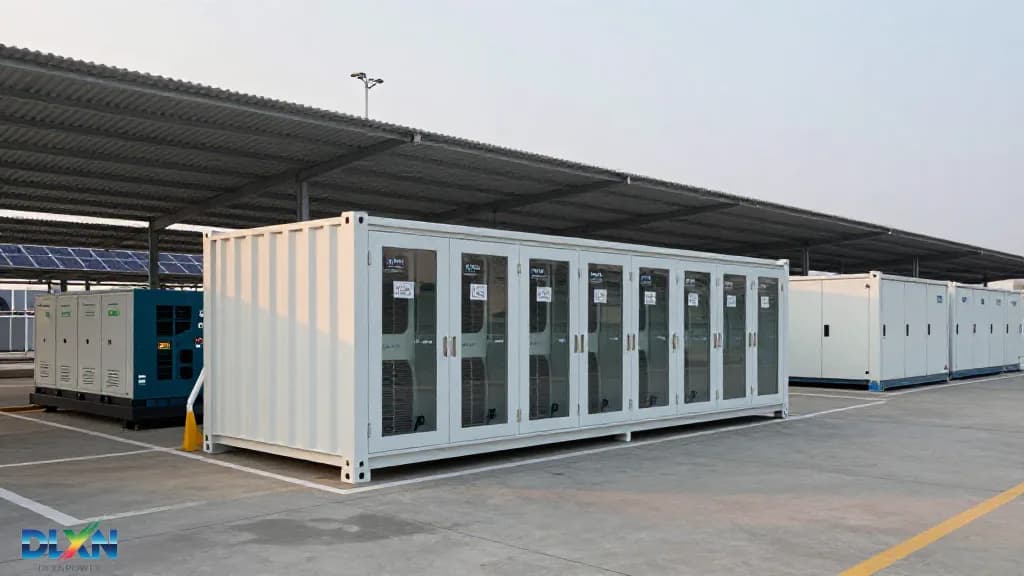
The strongest commercial case is rarely storage alone. Pairing a rooftop or canopy PV array with a BESS lets a facility charge from its own generation, discharge into evening peaks, and keep the battery as an outage reserve. Structural options such as a solar-plus-storage [EOS carport](/eos-carport) convert existing parking into generation and shaded parking simultaneously, with no additional land cost — a decisive advantage where roof area is exhausted or structurally limited.
Design sequencing matters. A solar-plus-storage hybrid should be sized on the annual load profile, then on the peak-demand interval, then on the required outage autonomy — in that order. Oversizing PV relative to battery capacity produces clipping and export at unfavorable rates; undersizing storage forfeits the demand-charge savings that carry most of the payback. According to NREL, well-designed C&I solar-plus-storage systems commonly achieve simple paybacks of five to eight years in high-demand-charge markets, before incentive stacking.
Safety, Codes and Procurement Decisions
Code compliance is where traditional and modern systems are least comparable. NFPA 855 requires lithium-ion installations to maintain three feet of separation from walls and exposures, or a one-hour fire-rated barrier, with unit-level listings to UL 9540 and thermal runaway testing to UL 9540A. Interconnection now requires UL 1741 SB-certified inverters meeting IEEE 1547-2018 ride-through and trip settings. Diesel, by contrast, faces fuel storage, spill containment and air-permit obligations that vary sharply by jurisdiction.
The procurement question therefore reduces to duty cycle. If a site needs 20–50 hours of continuous outage autonomy at high load — a hospital, a remote pump station — a generator remains irreplaceable, and storage serves as a bridging asset. If the requirement is sub-second response, daily cycling, demand reduction and incentive capture, a BESS wins on both cost and capability. Reviewing [delivered commercial projects](/projects) is the fastest way to benchmark expected savings against a specific load profile before committing capital.