The Architectural Divide: How the Two Designs Actually Differ
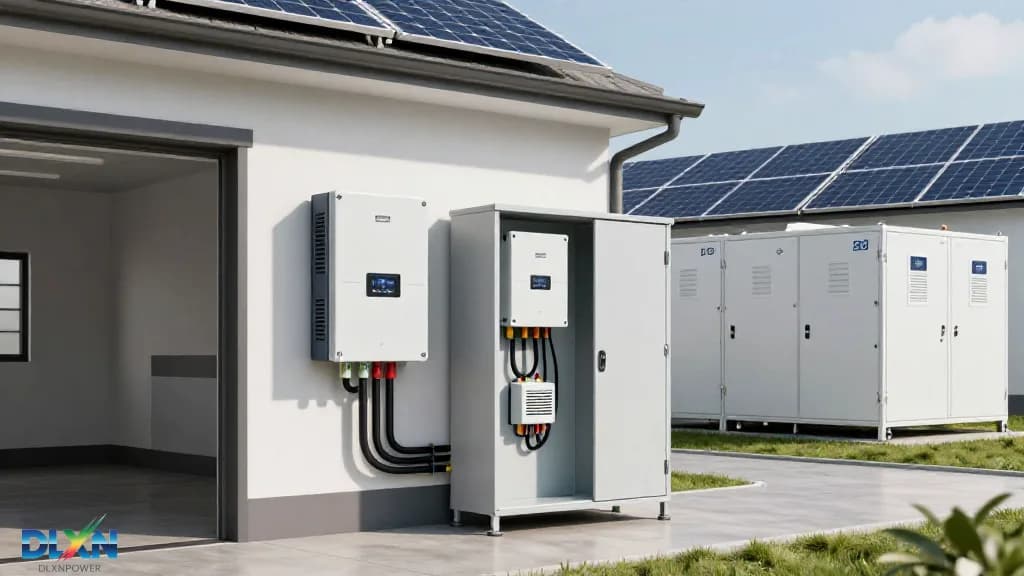
An all-in-one solar power and storage system consolidates the hybrid inverter, maximum power point tracking (MPPT) stage, battery modules, battery management system (BMS) and energy management system (EMS) into a single enclosure with a shared DC bus. Manufacturers such as Tesla (Powerwall 3), Huawei (LUNA2000), Sungrow and Growatt now ship units rated between 5 kW and 15 kW with 10–30 kWh of usable storage, a single grid interconnection point and one integrated automatic transfer switch. The result is a system with perhaps two or three field-installed components instead of eight or more.
A traditional architecture separates every function. A string inverter converts PV DC to grid AC; a separate AC-coupled battery cabinet contains its own inverter, charger and BMS; an external gateway or data logger handles monitoring and demand response; and a standalone transfer switch or critical-loads panel provides backup. According to NREL's U.S. Solar Photovoltaic System and Energy Storage Cost Benchmark, this disaggregated design carries a higher balance-of-system (BOS) count, more conduit and wiring runs, and additional permitting and inspection touchpoints.
The distinction matters because each architecture forces a different conversion pathway. Traditional AC-coupled systems route power through alternating current at every stage between the array, the battery and the loads. All-in-one designs keep the array, battery and backup loads on a common DC link, converting to AC only once at the point of grid interaction. That single architectural choice cascades into measurable differences in efficiency, cost and reliability.
Conversion Efficiency and Round-Trip Losses
Round-trip efficiency is where the DC-coupled, all-in-one topology earns its reputation. In an AC-coupled system, PV DC is inverted to AC (roughly 96–98% efficient), then rectified back to DC to charge the battery (94–96%), then inverted again to serve loads or export (96–98%). Compounded, those three stages typically yield 85–90% usable round-trip efficiency. A DC-coupled all-in-one system performs one DC-DC conversion into the battery and one DC-AC conversion out, producing measured round-trip figures of 90–94% in most commercial products.
Battery chemistry reinforces the gap. High-voltage lithium iron phosphate (LFP) packs operating at 400 V and above — now the default in integrated systems — carry less resistive loss and require thinner cabling than legacy 48 V architectures. Our own [battery storage engineering notes](/tech/battery-storage) detail how cell-to-inverter DC resistance, not cell chemistry alone, drives a 1–3% efficiency delta even between otherwise comparable LFP modules.
Backup performance is a related metric. Integrated hybrid inverters with solid-state transfer switches typically transition to islanded mode in under 20 milliseconds, well inside the 20–100 ms window that causes most IT equipment and variable-speed motors to drop out. Traditional setups using external contactors or manual transfer switches often exceed 100 ms unless a dedicated UPS is added, which introduces yet another conversion stage and another maintenance item.
Installation Labor, Balance-of-System and Footprint
Soft costs dominate residential solar economics. NREL consistently finds that non-hardware costs — labor, permitting, inspection, interconnection and customer acquisition — represent roughly 60–65% of the installed price of a residential PV system in the United States. Component count is the primary lever a designer controls: every additional enclosure means another mounting kit, another set of DC or AC conductors, another torque specification and another inspection item.
Integrated systems compress this. A single-wall-mounted unit with a pre-assembled battery stack can reduce field labor from two days to one for a typical 8 kW / 20 kWh residential installation. Depending on regional labor rates, that translates into $600–$1,500 of avoided cost per project, before accounting for reduced truck rolls and fewer callbacks. For EPCs running volume, the scheduling benefit frequently outweighs the hardware premium.
Footprint behaves differently across segments. In a suburban garage, rack-mounted components are unremarkable; in a Tokyo apartment block, a Lisbon townhouse or a dense urban retrofit, wall area is scarce. Integrated units typically occupy 0.5–1.0 m² versus 1.5–2.5 m² for a disaggregated equivalent. In solar carport and canopy projects such as our [EOS carport platform](/eos-carport), consolidating storage into a single weather-rated enclosure also simplifies structural loading calculations and reduces the number of penetrations through the canopy deck.
Reliability, Warranty and System Intelligence
The classic objection to all-in-one design is the single point of failure: if the hybrid inverter fails, the array and the battery both go dark. That risk is real but quantifiable. Modern integrated platforms use modular battery stacks with independent BMS channels and multiple MPPT trackers, so a single module or string fault degrades capacity rather than causing full outage. The residual exposure is the inverter stage itself, which typically carries a 10–12 year product warranty with options to extend to 20 years.
The traditional architecture distributes that risk but also distributes accountability. When an AC-coupled system underperforms, the site owner may need to coordinate three vendors — inverter, battery and monitoring — before anyone accepts responsibility. Integrated platforms collapse that into one warranty contact, one firmware release cadence and one telemetry stream, which matters enormously at portfolio scale. IEEE 1547-2018 and UL 1741 SB compliance, including smart inverter functions like volt-watt and frequency-watt, is also simpler to certify and maintain when a single firmware governs all grid-interactive behavior.
Certification is not optional. NFPA 855 and the International Fire Code impose separation distances, maximum stored energy per unit and ventilation rules on lithium installations, while UL 9540 covers the complete energy storage system and UL 9540A addresses thermal runaway propagation. Integrated products are generally certified as complete systems, which removes ambiguity during plan review. Our [hybrid inverter selection guide](/tech/inverters) covers the specific certification and grid-code questions specifiers should raise before procurement.
Scalability, Retrofits and Manufacturer Lock-In
Traditional AC-coupled architecture wins decisively on one axis: retrofit flexibility. A homeowner with an existing string inverter can add storage years later without touching the PV array or its interconnection agreement. In mature markets this is the dominant pathway — BloombergNEF and European trade bodies consistently report that retrofit storage represents a large share of residential battery additions in Germany and Australia, where hundreds of thousands of PV systems were installed before storage was economic. AC coupling also allows batteries from one vendor to pair with inverters from another, preserving negotiating .
All-in-one systems trade that flexibility for integration depth. Capacity is bounded by the inverter rating and the number of battery modules the enclosure accepts, so exceeding the design ceiling usually requires a second unit rather than a simple module addition. Battery expansion modules are frequently manufacturer-specific, creating a form of lock-in that should be priced into the total cost of ownership rather than ignored.
The practical middle ground is a modular hybrid platform: DC-coupled for efficiency, but with stackable battery modules, multiple MPPT inputs and an open Modbus or SunSpec interface for third-party EMS integration. That configuration preserves upgrade headroom while retaining the wiring, labor and efficiency advantages of integration. It is the architecture we specify most often for commercial and industrial clients, including ground-mount and remote installations documented in our [project portfolio](/projects).
Economics: Capex, LCOS and Payback Horizons
On capital cost, integrated systems currently carry a modest hardware premium that is usually offset downstream. BloombergNEF's annual battery price survey placed volume-weighted average lithium-ion pack prices near $115/kWh in 2024, down more than 80% from 2013 levels. Combined with a hybrid inverter priced at roughly the same level as a standalone string inverter plus a separate battery inverter, the incremental capex for integration is often in the range of $0–$400 per installation, before labor savings are counted.
Levelized cost of storage (LCOS) tells a more complete story. BloombergNEF's 2024 analysis puts utility-scale four-hour systems near $100/MWh in favorable markets; behind-the-meter residential and commercial systems run considerably higher, typically $150–$350/MWh depending on cycling frequency, tariff structure and battery life. Higher round-trip efficiency directly reduces LCOS, because every kilowatt-hour lost in conversion must be repurchased or forgone. A five-point efficiency gain on a heavily cycled 20 kWh residential system is worth meaningful money over a 10-year life.
Payback depends on the revenue or avoidance stream. Under time-of-use arbitrage alone, commercial behind-the-meter storage in high-spread markets such as California, South Australia or parts of Germany commonly reaches payback in four to seven years. Adding demand charge management, backup value and the 30% federal Investment Tax Credit available under the Inflation Reduction Act in the United States compresses that further. The IEA's 2024 renewables report confirms solar PV as the largest source of new generation capacity worldwide, which in turn strengthens the case for pairing every new array with storage at the design stage rather than retrofitting later.
Application Fit: A Practical Decision Framework
Choose an all-in-one system when the storage and PV are installed together, when wall space or weather exposure is constrained, when a single warranty contact and unified monitoring reduce O&M overhead, and when the design load profile fits comfortably within one unit's power and energy envelope. Residential rooftop retrofits, telecom and agricultural off-grid sites, and small commercial buildings with straightforward backup requirements all fit this profile. Our [residential lithium battery range](/products/lithium-battery) is engineered around exactly these constraints.
Choose a traditional, component-based architecture when the PV array already exists and only storage is being added, when multiple vendors must be kept in competition across a large portfolio, when capacity must scale in fine increments, or when a three-phase commercial site needs independent redundancy across inverters. Large industrial sites with separate O&M contracts for generation and storage also tend to prefer disaggregation, since it keeps failure domains isolated.
The deciding variable is rarely technology — it is timing and scale. Integrated systems reward projects designed as a whole; traditional systems reward projects assembled incrementally. Specifiers who model round-trip efficiency, soft costs, warranty structure and expansion headroom before selecting a topology will find the answer usually emerges from the numbers rather than from marketing claims. In most new-build residential and light commercial projects today, that arithmetic favors integration.