Integrated Architecture: From Component Stack to Single Appliance
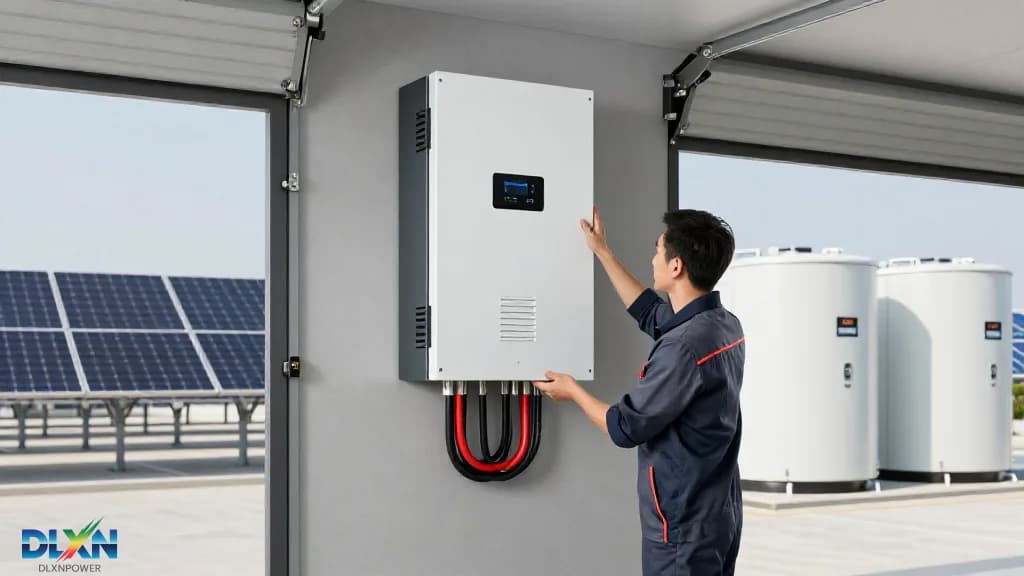
The defining change of 2025 is architectural consolidation. Where a 2019 residential system required a string inverter, a separate AC-coupled battery, a gateway and three apps, today's all-in-one units integrate DC-DC MPPT conversion, bidirectional inverter, battery management and energy management into one NEMA 3R enclosure. Tesla's Powerwall 3 delivers 13.5 kWh usable capacity and 11.5 kW continuous output with six integrated MPPTs, while Enphase's IQ Battery 5P provides 5.0 kWh modules with 3.84 kW continuous and 7.68 kW peak output. Our own [all-in-one system range](/products) follows the same DC-coupled philosophy.
The efficiency argument is quantifiable. DC coupling avoids a redundant AC-DC-AC conversion, and manufacturers report round-trip efficiencies of 92–96% versus roughly 85–90% for legacy AC-coupled retrofits. Fewer conversion stages also mean fewer failure points. According to NREL's cost modelling, balance-of-system hardware and labour represent roughly a quarter to a third of installed residential storage cost, so collapsing those components into a factory-tested enclosure directly reduces both capex and commissioning time.
Commercial and industrial hardware has followed a parallel path. Liquid-cooled cabinets such as Huawei's LUNA2000-215-S1 pack 215 kWh and 100 kW of bidirectional conversion into a single outdoor-rated unit, with four to six cabinets paralleled per transformer. The result is a 1 MWh / 500 kW building block that ships pre-assembled, pre-tested and pre-certified, cutting site labour by an estimated 40–50% compared with rack-by-rack builds.
Battery Cells in 2025: 314 Ah LFP, Sodium-Ion and Cycle-Life Economics
Cell format is where the cost curve moved fastest. Stationary storage has standardised on prismatic LFP, with capacity stepping from 280 Ah to 314 Ah mainstream cells and now 587–628 Ah units from CATL, EVE and Hithium. Larger cells reduce the number of interconnects, busbars and welds per kilowatt-hour, improving both reliability and $/kWh. CATL's TENER platform, a 6.25 MWh twenty-foot container with 430 Wh/L energy density, claims zero capacity degradation over its first five years — a notable departure from the traditional 2–3% annual fade assumption.
Cycle-life specifications have also firmed up. Premium LFP cells now warrant 8,000–12,000 cycles at 80% depth of discharge to 70% state of health, equivalent to 20-plus years of daily cycling in stationary duty. That durability underpins the 10-year product warranties and optional 15-year performance guarantees now common in the residential segment. Detailed performance curves and degradation data are available in our [lithium battery technical library](/products/lithium-battery).
Sodium-ion chemistry reached commercial maturity in 2025. CATL's Naxtra cells, rated at 175 Wh/kg and entering mass production this year, retain usable capacity at −40 °C and avoid lithium, cobalt and nickel entirely. For cold-climate stationary applications — Nordic residential backup, Canadian telecom sites — sodium-ion's temperature tolerance removes the need for active heating, which can otherwise consume 5–10% of a lithium system's usable energy in winter.
Power Electronics: Silicon Carbide, Grid-Forming Control and Oversizing
The inverter is now the intelligence centre of the system. Silicon-carbide MOSFETs have displaced silicon IGBTs in premium hybrid platforms, pushing peak conversion efficiency to 97.5–98.4% while allowing switching frequencies high enough to shrink magnetics and cut enclosure volume. Modern hybrid units accept DC oversizing of 150–200%, letting a 5 kW inverter carry 10 kWp of array so clipping losses are traded for higher winter yield — a rational trade in most temperate climates. Details on topology and efficiency curves are in our [inverter technology section](/tech/inverters).
Grid interaction has matured alongside the hardware. Under UL 1741 SB and IEEE 1547-2018, inverters must provide autonomous grid-support functions: volt-VAR, frequency-watt, volt-watt and ride-through. In practice this means a certified all-in-one system now helps stabilise the local network rather than simply disconnecting when voltage drifts. NREL's grid-forming research has demonstrated that inverter-based resources with virtual inertia can supply synthetic inertia comparable to synchronous machines on weak networks, and several 2025 residential platforms include black-start capability.
Backup performance is the specification most homeowners actually notice. Transfer times have fallen from 100–200 ms in early AC-coupled systems to under 20 ms in DC-coupled designs, fast enough that electronics and variable-speed motors ride through an outage. Combined with 11.5 kW continuous output, a single all-in-one unit can now carry a whole-house load — heat pump, EV charger and well pump — rather than the critical-loads subpanel that defined the previous generation.
Software, AI Forecasting and Virtual Power Plant Participation
Hardware differentiation is narrowing; software is where vendors now compete. Cloud-connected energy management systems use machine-learning forecasts of solar generation and household load across a 24–72 hour horizon, then optimise battery dispatch against retail tariffs. Platforms integrated with Octopus Agile, Tibber and Australia's Amber Electric can arbitrage wholesale price swings of 200–400% within a single day, adding several hundred dollars of annual value beyond self-consumption.
Aggregation has become a genuine revenue stream. FERC Order 2222 in the United States requires wholesale markets to accept distributed energy resource aggregations, and virtual power plants now routinely bid residential batteries into capacity and frequency-regulation markets. Green Mountain Power's Vermont VPP and Tesla's California fleet have demonstrated payouts of $500–1,500 per household per year in high-value markets. Measurement, telemetry and settlement for these services depend on the storage management layer described in our [battery storage technology overview](/tech/battery-storage).
Interoperability is the remaining friction point. Most serious platforms now expose SunSpec Modbus, IEEE 2030.5 and OpenADR 2.0b interfaces, allowing third-party aggregators and utility demand-response programs to dispatch the asset without vendor lock-in. Buyers should verify that a candidate system publishes an open API and permits third-party dispatch — a system that only responds to its manufacturer's own VPP forfeits a material share of lifetime value.
Safety, Standards and Certifications That Matter in 2025
Safety regulation has tightened considerably. In North America, UL 9540 (third edition) governs the complete energy storage system, while UL 9540A cell-level thermal runaway testing is now mandatory for most jurisdictions. NFPA 855 sets separation distances — commonly three feet (900 mm) from walls and openings for residential installations — and imposes capacity thresholds above which additional fire mitigation is required. IEC 62619 and IEC 62933 provide the equivalent international framework for cells and systems respectively.
Europe added a regulatory layer with the EU Battery Regulation (2023/1542). Carbon footprint declarations become mandatory for industrial batteries above 2 kWh from 2025, followed by digital battery passports in 2027 and supply-chain due-diligence obligations. For buyers, this means a compliant all-in-one system now arrives with traceable cell provenance, recycled-content documentation and an end-of-life take-back pathway — increasingly a procurement requirement for corporate and public-sector projects.
Engineering responses have also improved. Modern enclosures integrate deflagration venting, aerosol or gas detection, cell-level fusing and liquid or phase-change thermal management to hold cell temperatures within a 3–5 °C spread. NREL testing indicates that correctly designed LFP packs with active thermal management rarely propagate a thermal runaway event beyond a single module. Pair that with IP65 or NEMA 3R ratings and 10–15 year warranties, and the reliability gap between tier-one and budget hardware is now measurable.
Cost, Market Data and Real Deployments
Costs fell sharply in 2024 and continued into 2025. BloombergNEF's December 2024 battery price survey recorded a volume-weighted average pack price of $115/kWh, a 20% year-on-year decline — the largest drop since 2017. Turnkey installed pricing follows at roughly $700–1,000/kWh for residential systems in the United States, $300–450/kWh for commercial cabinets, and $180–250/kWh for four-hour utility-scale BESS. The IEA reported that battery storage additions doubled to about 42 GW in 2023, with grid-scale projects taking roughly two-thirds of that total.
Policy is amplifying the trend. Australia's Cheaper Home Batteries Program, launched 1 July 2025, applies a discount of approximately 30% to residential battery installations, building on a rooftop solar fleet exceeding four million systems. Germany's Solarspitzengesetz removed feed-in remuneration during negative-price hours, making self-consumption and storage economically compelling. In the United States, the 30% investment tax credit remains available for standalone storage, and hybrid projects retain full eligibility.
Deployment is broadening beyond single-family homes. Commercial rooftops, carports and microgrids are adopting all-in-one cabinets, including integrated structures such as our [EOS solar carport](/eos-carport), which combines generation, weather protection and EV charging on one footprint. Puerto Rico, Hawaii and South Africa have become reference markets where storage is specified for resilience rather than arbitrage — a shift that is reshaping how systems are sized and valued worldwide.
Specifying a System in 2025: A Practical Checklist
Start with the load, not the hardware. A typical European or North American home needs 10–20 kWh of usable storage for one day of autonomy excluding heating and EV charging; adding a heat pump or an electric vehicle pushes that to 25–40 kWh. Commercial sites should size for 2–4 hours at peak demand. Undersizing forces daily deep discharges, which accelerates degradation; oversizing wastes capital that could instead buy additional array capacity.
Then verify the technical fundamentals. Confirm round-trip efficiency above 90%, continuous power output that matches your peak load, C-rate capability of at least 0.5C, and expansion capacity for future modules. Check that the product carries UL 9540/9540A or IEC 62933 certification with the specific configuration you are buying, and read the warranty's throughput clause — not just the year count. A 10-year, 6,000-cycle warranty is a materially different asset from a 10-year, 12,000-cycle one.
Finally, evaluate the : local service coverage, monitoring granularity, firmware update cadence and open dispatch interfaces. The best all-in-one system in 2025 is not the one with the largest nameplate capacity, but the one whose software, safety certification and service network continue to deliver value fifteen years after commissioning.