What Each Device Actually Does
A traditional inverter is a unidirectional power converter. It tracks the maximum power point of a PV array, boosts DC voltage to a stable internal bus, and synthesizes a current waveform synchronized to the grid. It has no battery port, no islanding capability and no ability to absorb power. Premium examples such as the SMA Sunny Boy or Fronius Primo reach 97.5–98.3% CEC-weighted efficiency, and their control logic is deliberately simple: harvest everything, push it to the grid, shut down when the grid disappears.
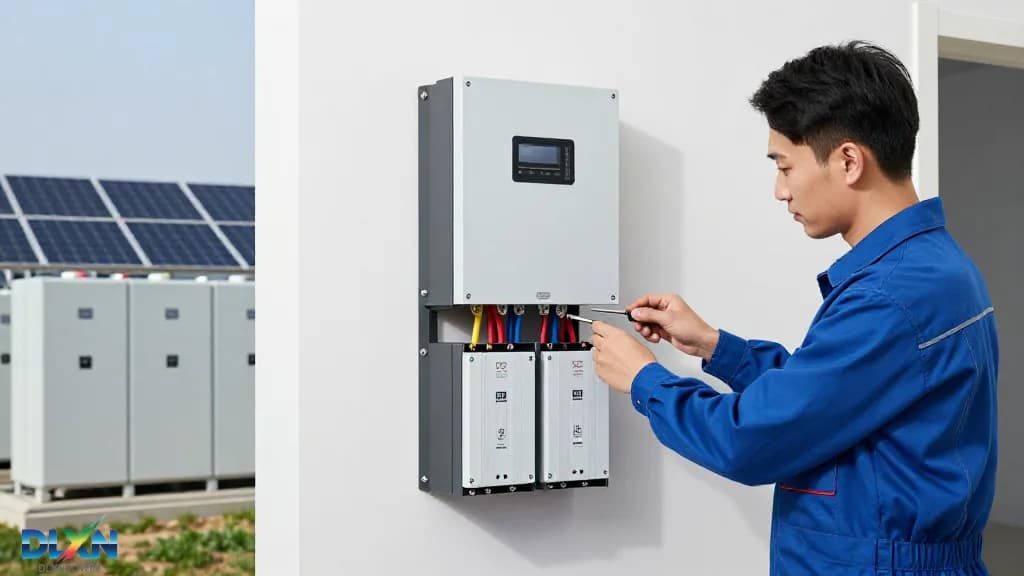
A battery storage inverter — also sold as a hybrid inverter, multi-mode inverter or, at utility scale, a power conversion system (PCS) — is bidirectional and four-quadrant. It performs the same MPPT and DC-AC conversion, but adds a regulated DC-DC stage for a battery bus, an automatic transfer device for backup loads, and firmware that can charge, discharge, peak-shave, export-limit and form its own voltage reference when the grid is absent. Our overview of [hybrid inverter topologies](/tech/inverters) covers how these stages are arranged.
The practical difference is not efficiency or build quality. It is function. A traditional inverter converts sunlight; a storage inverter converts sunlight and dispatches stored energy on command — which is why it now sits at the center of virtually every new residential design brief.
Topology, Conversion Stages and Round-Trip Losses
Traditional inverters win on conversion physics. With a single DC-AC stage and no battery coupling, they lose roughly 1.5–3% of harvested energy and draw only 0.5–3 W at night. Hybrid units add conversion stages and parasitic loads: a typical wall-mounted hybrid draws 15–40 W continuously to keep the battery BMS, communications and DC bus alive, which is 130–350 kWh per year of standby consumption.
Battery architecture dominates round-trip efficiency. In AC-coupled designs, PV is converted to AC by a string inverter, then rectified back to DC to charge the battery — power crosses the conversion boundary twice. Expect 85–90% round-trip. In DC-coupled hybrids, PV feeds the battery bus directly and only the discharge leg is inverted, reaching 90–94%. According to NREL's storage cost and performance work, LFP cells themselves return 95–96% at cell level, so the inverter is where most of the loss accrues.
Utility-scale PCS units behave differently again. A 1500 V DC central PCS rated 3.4–6 MW now reaches 98.5–99% peak efficiency with silicon-carbide switching, and is specified for reactive power, voltage ride-through and frequency droop under IEEE 1547-2018 and IEEE 2800-2022 rather than for round-trip economy alone.
Cost: Capital, Replacement and the Real Payback
Hardware cost has converged faster than most installers expected. Traditional string inverters currently retail at roughly $0.05–0.12 per watt, while hybrid storage inverters run $0.15–0.30 per watt before the battery. A 10 kW hybrid therefore carries a $1,000–$1,800 premium over its string equivalent — small compared with the battery itself.
Battery economics remain the dominant line item. BloombergNEF's annual price survey put the global average lithium-ion pack price at $115/kWh in 2024, down roughly 20% year on year. Installed residential storage, however, is a different number: NREL's cost benchmarks place U.S. residential retrofits near $1,000–$1,400 per kWh of usable capacity once labour, permitting, transfer equipment and margin are included. A 10–13.5 kWh system therefore lands at $10,000–$16,000 installed.
Payback now hinges on tariff structure rather than hardware price. Under California's NEM 3.0 net-billing regime, export compensation fell sharply, and storage attachment rates on new PV systems climbed above 50% in the state's major utilities. In Germany, where feed-in tariffs are modest, self-consumption ratios of 70%+ are routine for hybrid systems. The hybrid inverter's cost is usually justified by backup power, time-of-use arbitrage and demand-charge reduction rather than by energy arbitrage alone. Comparing configurations across our [battery storage systems](/tech/battery-storage) shows how quickly the marginal case improves with a second daily cycle.
Reliability, Lifetime and Failure Modes
Traditional inverters have a well-characterized failure profile. Sandia and NREL field studies put annual failure rates for residential string inverters near 1–2%, with electrolytic capacitors, cooling fans and surge-protection components as the leading causes. Warranties of 10–12 years are standard, extendable to 20–25 years, and a mid-life replacement around year 12–15 is normally budgeted into a 25-year PV model.
Hybrid inverters inherit those failure modes and add thermal cycling from daily battery charge-discharge. A unit cycling once per day at 0.5C experiences roughly 7,000 additional thermal excursions over a 20-year life compared with a PV-only inverter. Manufacturers mitigate this with sealed, fanless enclosures, wider derating margins and overspecified magnetics, but the practical outcome is a 10-year standard warranty rather than 12, and a stronger case for extended coverage.
Certification scope also differs. A hybrid must satisfy UL 1741 SB for grid support, UL 9540 for the energy storage system, UL 1973 for the battery modules and, in Australia, AS/NZS 4777.2. Many utilities additionally require IEEE 2030.5 (CSIP) or SunSpec Modbus for remote curtailment. A traditional inverter needs only the grid-interconnection portion. That extra compliance burden is a real cost driver, and a real risk if an installer specifies a unit without the utility's required protocol.
Architecture Choices in Real Installations
Retrofit projects usually favour AC coupling: the existing string inverter stays, and an AC-coupled battery inverter is added at the main panel. This preserves the original PV warranty, allows incremental capacity additions, and lets the battery sit closer to the loads. Its penalty is the double conversion and a second inverter to maintain. It remains the default for customers adding storage to a system installed after 2015.
New-build projects increasingly go DC-coupled hybrid, where one enclosure handles PV MPPT, battery management and backup transfer. Transfer times of 10–20 ms mean electronics ride through the outage without rebooting, and a single monitoring platform simplifies service. For larger sites, three-phase hybrids in the 30–125 kW class handle peak shaving and demand-charge management, often paired with high-voltage [lithium iron phosphate battery modules](/products/lithium-battery) rated for 6,000+ cycles at 80% depth of discharge.
At utility scale, the architecture question is central versus string PCS. Central PCS units dominate above 100 MWh for cost per watt, while string PCS is gaining share in projects below 30 MWh where availability and granular MPPT matter more. Reference installations such as Hornsdale Power Reserve in South Australia — expanded to 150 MW/193.5 MWh — demonstrated that fast frequency response and grid-forming controls can displace conventional frequency-regulation services. Reviewing [deployed projects](/projects) shows how these trade-offs play out in practice across climates and tariff regimes.
Specification Checklist and Decision Framework
Start with the question the traditional inverter cannot answer: does the customer need power when the grid is down? If yes, a hybrid or AC-coupled storage inverter is mandatory. If no, the decision narrows to whether time-of-use arbitrage, demand charges or export limits justify the added cost within the warranty period.
Then specify hard numbers. For residential hybrids, look for continuous AC output rather than peak (a 10 kW peak unit may deliver only 5 kW continuously), surge capability for motor loads, battery voltage window compatibility, at least two MPPTs, CEC efficiency above 97%, round-trip efficiency above 90%, transfer time under 20 ms, and grid-forming capability if the site may become a microgrid. Confirm UL 1741 SB, UL 9540 and the local interconnection protocol before ordering.
Sizing discipline matters more than brand. Size the battery for the critical load panel, not the whole house, and choose a C-rate (0.5C is typical for LFP) that matches the inverter's continuous rating so neither component is throttled by the other. Where a site also needs new generation, pairing a hybrid with high-efficiency [solar panels](/products/solar-panels) typically reduces the battery capacity required to hit a given backup duration.
Where the Market Is Heading
The IEA's renewable energy market reports now treat battery storage as the fastest-growing flexibility asset in the power system, and BloombergNEF projects annual global storage installations exceeding 100 GW by 2030. Two technical shifts accompany that growth. First, grid-forming capability is moving from a premium feature to a baseline requirement, as system operators in Australia, Texas and parts of Europe reward inverters that can supply synthetic inertia and black-start capability.
Second, the traditional standalone string inverter is not disappearing — it is being repositioned. In markets with strong export tariffs and no backup requirement, a high-efficiency string inverter plus a separate AC-coupled battery remains the cheapest compliant option. In markets with weak export compensation and rising outage risk, the hybrid inverter has effectively become the default. The dividing line is no longer technical capability but tariff design and resilience value.
For most new residential and light-commercial projects in 2025, a DC-coupled hybrid with an LFP battery is the safer specification: slightly lower efficiency at the conversion stage, materially higher value at the system level. Retrofits and pure-export arrays should stay with conventional inverters until economics justify otherwise. Either way, specify the protocol, the certification and the continuous rating before the price. Our engineering team can review [system designs and interconnection requirements](/contact) against local utility rules.