Sizing the System: Load Analysis and Battery Capacity
Before ordering a single module, you must quantify what the kit must power. Start by pulling 12 consecutive months of electricity bills and calculating a daily average. According to U.S. EIA data, the average American home consumes roughly 10,600 kWh annually — about 29 kWh per day — but that figure varies widely with HVAC loads, EV charging, and water heating. For a more granular view, install a clamp-on energy monitor on your main breaker panel for two weeks to record time-of-use patterns and identify the critical loads you want backed up: refrigerators (150–400 W), furnace blowers (800 W), medical devices, and Wi-Fi routers.
Battery capacity math is where most undersizing errors occur. If your goal is overnight self-consumption, target 1.2 to 1.5 times your evening baseload. A 13.5 kWh usable-capacity lithium battery, for example, comfortably carries a typical 3–4 kW evening load through the night. But if whole-home outage resilience is the priority, use a three-day autonomy calculation: 29 kWh/day × 3 days ÷ 0.90 depth-of-discharge = roughly 97 kWh, which pushes most homes into a multi-battery configuration. Consider the C-rate as well: a 0.5C battery rated at 10 kWh delivers a continuous 5 kW, so pair your largest continuous loads against inverter output, not just nameplate capacity. Explore our [kit battery sizing options](/products/lithium-battery) to match capacity and discharge rate to your exact load profile.
Selecting Panels, Inverters, and Battery Chemistry
Your solar array size dictates inverter and battery sizing. A typical rooftop supports between 6 kW and 12 kW of PV; modern residential modules deliver 400–550 W at 21–23% efficiency, so a 7.6 kW array needs roughly 15 to 19 modules depending on module wattage. High-efficiency panels reduce roof coverage and leave expansion room as loads grow, making them a sensible long-term choice. Review current [residential solar panel specifications](/products/solar-panels) for temperature coefficients and degradation guarantees—two factors that strongly influence real-world yield over a 25-year lifespan.
For storage, lithium iron phosphate (LFP) chemistry has become the default for stationary home systems, displacing NMC due to safety and cycle life. BloombergNEF reported that global average lithium-ion battery pack prices fell to roughly $115/kWh in 2023 for EV-grade cells, though residential energy storage systems still cost far more at the system level because of power electronics, enclosures, and installation labor. LFP batteries typically deliver 6,000 cycles at 80% depth-of-discharge, translating to 16–20 years of daily cycling. Your choice of inverter topology also matters: a hybrid inverter combines PV and battery conversion in one unit, while AC-coupled systems add batteries to existing solar inverters. Both must carry UL 1741 certification and meet IEEE 1547 grid-interconnection requirements.
Safety Certifications, Permitting, and Interconnection
Code compliance begins long before tools come out. In the U.S., solar PV and energy storage installations fall under National Electrical Code (NEC) 2023, specifically Article 690 for PV systems, Article 706 for energy storage systems, and Article 710 for stand-alone systems. Module-level rapid shutdown per NEC 690.12 is mandatory and requires UL-listed power optimizers or microinverters. The battery itself must be UL 9540 certified as a system, and if installed indoors, it should meet UL 9540A fire-testing criteria to minimize combustion-propagation risk. Confirm all component certifications before buying.
Next, obtain a building permit from your local authority having jurisdiction (AHJ) and submit an interconnection application to your utility. Permit lead times vary from one week in municipalities to six weeks in denser jurisdictions; interconnection approval for a UL 1741-certified inverter can take an additional 2–10 weeks depending on whether net metering or a smart-inverter tariff applies. Many utilities now require inverter settings that respond to frequency and voltage fluctuations per IEEE 1547-2018. When replacing or upgrading main service panels for a 200-amp bus, consult a licensed electrician early — this is the most common hidden cost of storage retrofits. Understand the [grid-tied hybrid inverter requirements](/tech/inverters) before you commit.
Site Survey and Mechanical Installation
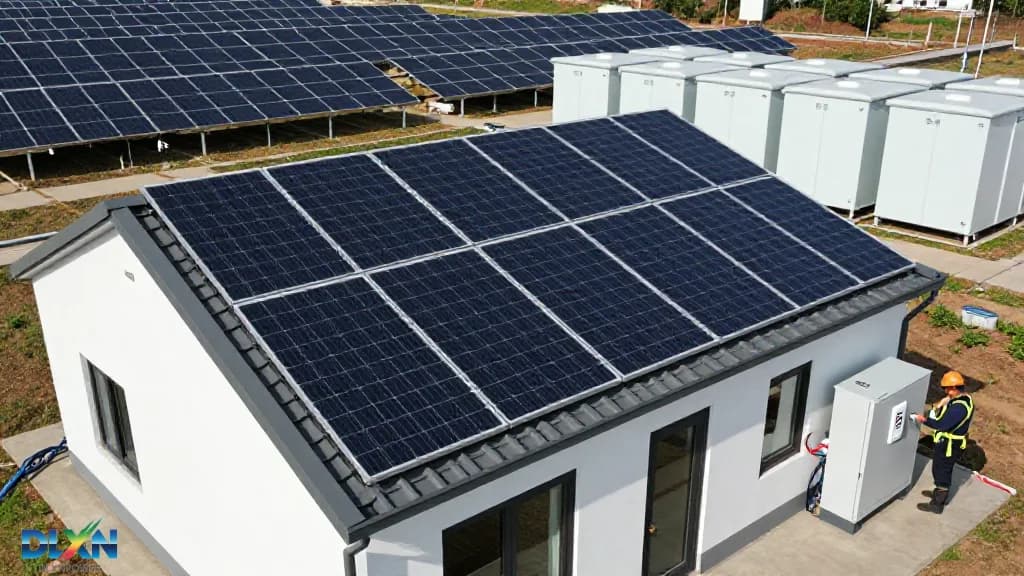
A thorough site survey protects the hardware investment. Confirm that your roof structure can support added dead load — most residential framing handles 30 psf or more, and a photovoltaic array adds only about 3.5 psf when ballasted and 2.5–3 psf when penetrating mounts are used. Inspect the roofing membrane and sheathing; if a re-roof is needed within 10 years, install the solar system on new roofing to avoid costly removal and reinstallation. Use a solar-path calculator or shade-analysis tool to measure irradiance at 9 a.m., noon, and 3 p.m. on June 21 and December 21. Shading of even one string can cut full-system output by 10–15% annually unless you use microinverters or DC optimizers.
For the mechanical phase, begin by laying out racking based on module dimensions and local wind and snow loads. Flash every roof anchor with a proper flashing kit and sealant; unsealed penetrations are the number one cause of post-installation leaks. Set rail spacing to match module mounting points, and torque clamp bolts to manufacturer specifications — typically 16–20 N·m for M8 hardware that secures module clamps. Provide a 1.5–2 inch gap between modules and the roof plane for airflow, which reduces thermal power loss and lets debris drain naturally. Orient strings toward the equator, and remember that tilt angles between 20 and 35 degrees balance summer production against winter performance for most continental U.S. latitudes. For homes with unsuitable roofs, consider a ground-mount or covered-structure solution to improve service access and cooling airflow.
DC/AC Wiring, Inverter Mounting, and Battery Integration
Wiring rules under NEC 690 drive both safety and reliability. Use sunlight-resistant 10 AWG PV wire for DC runs, and size it for the inverter’s maximum input current plus a 25% continuous-operation margin as required by NEC 690.8. Overcurrent protection per NEC 690.9 is mandatory on each source circuit; install a fused combiner if you have three or more parallel strings. Route positive and negative conductors together to reduce induced voltage surges, and label the DC disconnects clearly at the inverter elevation. When using rapid shutdown devices, verify that the wake-up and shut-off communication is wired in a fail-safe manner.
Hybrid inverters need dedicate space near the main service panel. NEC 110.26 requires a minimum 36-inch working clearance in front of energized equipment, so never cram a 40 kVA-class inverter behind a workbench. Mount the inverter vertically, out of direct sun, with the heat-sink fins unobstructed. Connect battery banks using the manufacturer’s specified cable gauge — most 48-volt nominal LFP batteries use 2/0 AWG or larger for runs under 10 feet. Enable CAN-bus or RS-485 communication between the battery management system (BMS) and the inverter so charge limits, cell balancing, and fault alarms stay coordinated. A system with a poorly configured BMS-to-inverter handshake is a leading source of false shutdowns. See which [integrated battery-storage topologies](/tech/battery-storage) DLXN Energy recommends for clean voltage matching.
Commissioning, Testing, and Grid Interconnection
Commissioning is not complete when the lights turn on — it begins with tests performed before energization. Measure open-circuit voltage of each string to verify string length and polarity; a reversed string will show a negative value and can damage the inverter if not caught. Perform an insulation-resistance test between the DC circuit and ground, awaiting a reading above 250 V minimum. Evaluate ground continuity on all exposed metal conduit and racking, because a compromised equipment-grounding conductor turns an otherwise healthy system into a shock hazard. Record every reading in a central commissioning log; AHJ inspectors frequently ask to review these values.
Once energized, follow a stepped turn-on sequence: start the inverter without grid power to confirm anti-islanding functions, then connect the utility and watch the synchronization display. Verify that export limits match your interconnection agreement — many utilities require a 5 kW export cap even if the inverter is rated for higher output. Confirm battery charging begins in the correct window for your time-of-use tariff, and test the backup transfer switch by simulating a grid outage during proper notification protocols. Finally, register the system on the manufacturer’s monitoring platform, enable firmware auto-updates, and create notification thresholds for underperformance. After final inspection, keep copies of the permit, interconnection agreement, and warranty certificates. If you are unsure about any step, a licensed electrician with energy-storage experience should supervise the entire electrical phase before [contacting your local utility](/contact) for permission to operate.
Cost, Payback, and Long-Term Maintenance
Real-world pricing matters for financial decisions. NREL’s 2023 cost benchmark puts fully installed residential PV at about $2.70 per watt before tax credits; adding battery storage raises the total to roughly $1,000–$1,500 per installed kWh of storage capacity, depending on site complexity and backup-transfer equipment. For a 10 kW solar kit paired with a 25 kWh LFP battery, that means a pre-incentive investment of $50,000–$65,000. In the United States, the Inflation Reduction Act’s 30% Investment Tax Credit cuts the effective cost substantially, and state-level incentives can shave another 10–20%. The net price lands at $35,000–$45,000 for many turnkey installations.
Payback time depends on utility tariff structure. Homes under traditional net metering see payback periods of 7–10 years, while time-of-use customers using batteries for peak shaving can recover investment faster, especially where peak rates exceed $0.40/kWh and EV charging raises daily consumption. Systems rated for whole-home backup add resilience value beyond simple ROI — a measurable benefit in regions with frequent grid outages. Maintenance remains manageable: clean panels two to four times a year in dusty climates, inspect racking torque annually, and verify battery state-of-charge calibration every six months. Most LFP modules hold 80% capacity after 6,000 cycles, and hybrid inverters typically carry 10–12-year warranties. Budget for eventual battery module replacement after a decade and a half of operation. Use the [DLXN Energy product catalog](/products) to compare kit configurations and warranties side by side before you quote your project.