What Defines a Standalone Solar Power System
A standalone, or off-grid, solar power system is an electrically isolated generation plant. It comprises a PV array, a charge controller or hybrid inverter, a battery bank, and protection and monitoring equipment — frequently supplemented by a backup generator or a second renewable source. Because no utility interconnect exists, every kilowatt-hour consumed must first be harvested and stored on site. The array and battery are therefore sized against the site's worst-case solar month and its autonomy requirement, not against average annual irradiance.
That single constraint — no infinite grid buffer — reshapes the entire design discipline. Traditional grid-tied systems can be undersized relative to load and let the network absorb mismatch in both directions. Standalone systems cannot. Engineers apply oversizing factors, typically 1.2–1.5× on the array and two to five days of autonomy on the battery, depending on load criticality. Every inefficiency in the chain is paid for twice: once in generation capacity and again in storage capacity.
The market underpinning this architecture is substantial. According to the IEA and World Bank SDG7 tracking report, roughly 666 million people still lacked electricity access in 2023, and off-grid solar is the least-cost solution for a large share of them. GOGLA's market data show several million off-grid solar products sold annually, while commercial standalone deployments — telecom towers, mines, irrigation and remote monitoring — number in the hundreds of thousands of units. For module specifications, see [solar panels](/products/solar-panels).
The Traditional Grid: Architecture, Economics, and Hidden Assumptions
The traditional option — a grid connection — is fundamentally a shared-infrastructure play. A utility amortizes generation, transmission and distribution across millions of customers, so the marginal cost per kilowatt-hour at the meter is usually the lowest available. In most OECD markets, residential retail tariffs sit between $0.10 and $0.40/kWh. Lazard's 2024 levelized cost analysis puts unsubsidized utility-scale solar PV at roughly $29–$92/MWh, well below what a small isolated plant can achieve.
The hidden assumption is density. Grid economics depend on customers per kilometer of line. Where rural connection density falls below roughly 10–20 households per kilometer, the cost of extending medium- and low-voltage lines climbs steeply, and regulators increasingly conclude that off-grid service is cheaper. The World Bank has documented grid-extension costs in the thousands of dollars per kilometer in sparsely populated terrain, with per-connection costs that can exceed the price of a complete standalone solar home system.
Component Deep Dive: Batteries, Inverters, and Balance of System
The battery defines the standalone system's cost and lifespan. Modern lithium iron phosphate (LFP) cells deliver 4,000–8,000 cycles to 80% depth of discharge, 90–95% round-trip efficiency and a calendar life of 10–15 years in temperate climates. Lead-acid remains cheaper per kilowatt-hour of nameplate capacity but offers only 1,200–1,500 cycles at 50% depth of discharge with markedly worse efficiency, which raises the levelized cost of stored energy. Sizing methodology is covered in our [battery storage](/tech/battery-storage) overview.
Inverters are the second cost driver. A standalone hybrid inverter performs three jobs simultaneously: DC-DC maximum power point tracking, battery charge and discharge management, and DC-AC conversion. Modern units reach 96–98% conversion efficiency with total harmonic distortion below 3%, and they provide grid-forming capability — synthesizing their own voltage and frequency reference. That function is absent in grid-tied designs, where the utility supplies the reference. Compliance follows UL 1741 and IEEE 1547 in North America and IEC 62109 for inverter safety globally; see our [inverter technology](/tech/inverters) page for topology comparisons.
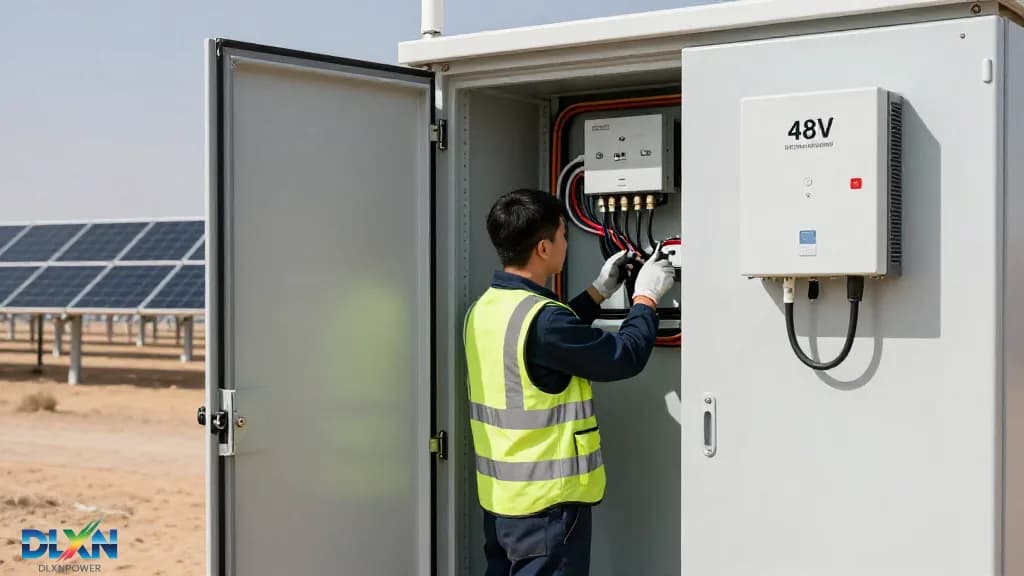
Balance of system matters more off-grid than on-grid. Voltage drops that are tolerable at 240 V become material at a 48 V DC bus, so designers keep DC runs short, specify bus voltages of 48 V or higher, and hold array-to-controller losses below 2%. Surge protection, DC-rated breakers and correct grounding are non-negotiable: a fault on an islanded system has no upstream protection device to clear it, so selective coordination must be engineered deliberately rather than inherited.
Levelized Cost of Energy: Standalone vs Grid Extension vs Diesel
The comparison hinges entirely on the counterfactual. If the grid is already at the property line, grid-tied solar almost always wins on cost. Lazard's 2024 analysis places utility-scale solar-plus-storage at roughly $38–$103/MWh and residential solar-plus-storage at roughly $117–$282/MWh unsubsidized, while bulk grid power is often cheaper still. Standalone systems cannot match those figures because they carry the full burden of storage, redundancy and on-site maintenance.
If the grid is not at the property line, the calculus inverts. IRENA and World Bank analyses repeatedly show diesel generation in remote locations costing $200–$500/MWh, and considerably more on islands where fuel logistics dominate. Replacing diesel with a standalone PV-battery plant typically cuts the levelized cost of energy by 50–70% and eliminates exposure to fuel price volatility and theft. That arithmetic is why mining operators, telecom tower companies and island utilities have become major standalone solar buyers.
The third case, grid extension, is a capital comparison rather than an energy comparison. Extending a distribution line several kilometers at $5,000–$15,000 per kilometer to serve a handful of customers can cost more per connection than a complete standalone system built around a [lithium battery](/products/lithium-battery) bank. Regulators across sub-Saharan Africa and South Asia increasingly encode this arithmetic directly into national electrification plans, treating off-grid service as a permanent rather than interim solution.
Reliability and Resilience: Where Standalone Systems Outperform
Standalone systems fail in modes that are local and diagnosable: a depleted battery, a failed inverter, an unexpectedly shaded array. Grid-tied systems fail in modes that are systemic and outside the customer's control. During the 2021 Texas winter storm, more than 4.5 million customers lost power; after Hurricane Maria, grid restoration in parts of Puerto Rico took nearly a year. For resilience-critical loads, an islanded system is the only architecture that fully decouples site availability from bulk power system health.
Standalone designs also distribute risk through modularity. Multi-string arrays, parallel inverters and multiple battery racks let operators shed non-critical loads instead of collapsing the whole system, and grid-forming inverter settings can prioritize loads by state of charge. Yield engineering compounds that resilience: dual-axis tracking, as used in the [Solar Sunflower](/solar-sunflower), can raise energy yield by roughly 25–45% compared with fixed-tilt mounting according to NREL field research — significant when every kilowatt-hour must be generated, stored and delivered on site.
Sizing and Design: A Practical Decision Framework
Start with the load, not the array. A defensible standalone design begins with a measured hourly load profile, separates critical from non-critical loads, then applies an autonomy requirement — commonly two to five days for residential use and three to seven days for telecom and health facilities, with generator backup covering extended deficits. Energy efficiency measures are usually cheaper than incremental battery capacity and should be pursued before any hardware is specified.
Then work backwards through the system derate. A practical chain is inverter efficiency (0.96), battery round-trip efficiency (0.92), wiring and mismatch losses (0.95), soiling and temperature derating (0.85), and charge controller efficiency (0.97). Multiplying these yields a system derate near 0.70, meaning each nameplate kilowatt-hour of array output delivers roughly 0.7 kWh at the load. Designing against the site's worst-month peak sun hours, rather than the annual average, prevents winter deficits that would otherwise force oversized storage.
Finally, compare architectures on lifecycle cost, not sticker price. A grid-tied system with net metering may show the lowest capital cost; a standalone system may show the lowest cost per delivered kilowatt-hour at a remote site. Documenting both options against the same load profile, the same reliability target and the same maintenance assumptions is the only way to produce a decision that survives scrutiny from a utility, a regulator or a project financier.