
The Traditional C&I Backup Stack and Its Limits
The legacy architecture was assembled piecemeal: a diesel genset for outage ride-through, a valve-regulated lead-acid (VRLA) UPS for IT and controls, a grid-tied PV array with no dispatchability, and manual demand-response participation via curtailment. Each element is single-purpose and sized for a worst case that occurs a few hours per year. A 500 kW diesel genset converts fuel at roughly 35–40% electrical efficiency, and most commercial units log fewer than 100 running hours annually under normal conditions. Capital sits idle for more than 99% of the year while fixed O&M, fuel polishing, and load-bank testing continue regardless.
Lead-acid chemistry imposes a second ceiling. According to IEEE battery standards work and NREL laboratory testing, VRLA cells deliver roughly 500–1,200 cycles at 50% depth of discharge with 75–80% round-trip efficiency — translating to replacement every three to five years in a cycling duty. Thermal sensitivity further narrows usable capacity: nameplate ratings assume 25 °C, and each 10 °C rise above that roughly halves service life. The result is a stack that is reliable on paper but expensive to operate and poorly suited to daily peak-shaving, which is precisely where most commercial energy spend accumulates.
Regulatory pressure is compounding the problem. EU Stage V and US EPA Tier 4 Final emission standards have driven up genset capital and aftertreatment complexity, while local air districts — California's SCAQMD being the most cited — cap annual non-emergency generator hours and require permits for new installations. Fuel storage adds Spill Prevention, Control, and Countermeasure obligations. For a facility trying to electrify operations, adding diesel capacity increasingly means adding compliance headcount rather than capability.
What a Modern BESS Delivers: Technical Benchmarks
Lithium iron phosphate (LFP) has become the default C&I chemistry. NREL and PNNL cycle-life studies show LFP cells sustaining 6,000–8,000 cycles to 80% state of health at 80% depth of discharge, with AC round-trip efficiency of 88–92% for coupled systems and up to 95% for DC-coupled architectures where a shared inverter serves both PV and battery. Response time is under 100 ms from setpoint command — roughly two orders of magnitude faster than a diesel genset reaching rated load after start and synchronization. The [battery storage architecture](/tech/battery-storage) matters here: DC coupling maximizes solar self-consumption, while AC coupling simplifies retrofits and backup isolation.
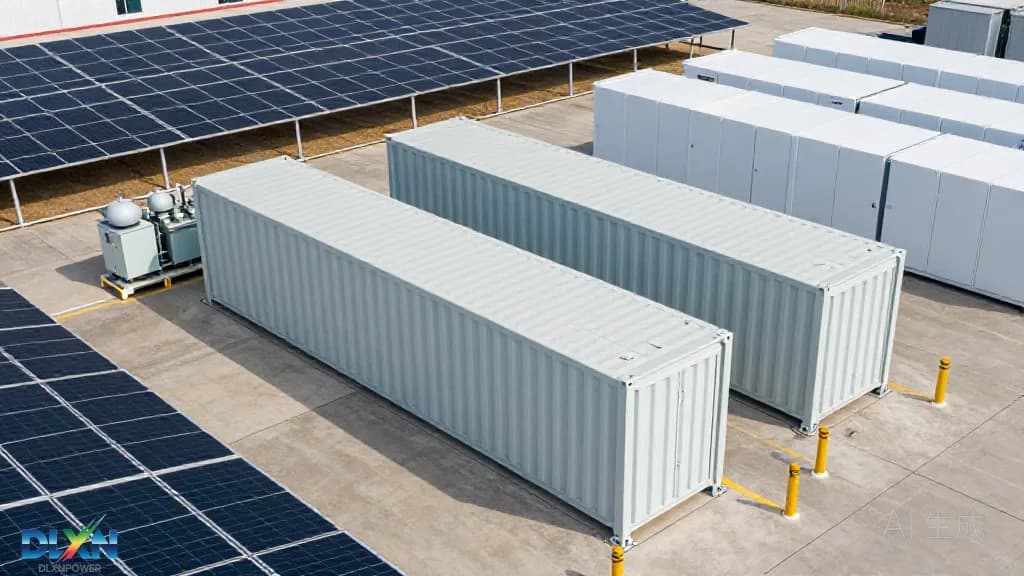
Physical density has improved comparably. A 20-foot containerized enclosure now houses 3.7–5 MWh of LFP capacity with liquid cooling, integrated HVAC, and aerosol or perfluorohexanone fire suppression, versus roughly 1 MWh for a comparable lead-acid footprint. Safety qualification follows UL 9540 for the system and UL 9540A cell-level thermal runaway testing, with NFPA 855 governing siting, separation distances, and maximum stored energy per fire area. Grid-interactive units comply with IEEE 1547-2018 and are certified to UL 1741 SB, enabling volt-VAR, frequency-watt, and ride-through functions required by many interconnection authorities.
The decisive advantage is multi-use dispatch. A single ESS governed by an energy management system can stack peak shaving, time-of-use arbitrage, backup transfer, and wholesale ancillary services across the same asset — a combination no generator can legally or technically provide. Commercial [lithium battery](/products/lithium-battery) platforms with open Modbus TCP or DNP3 interfaces let the EMS arbitrate between these revenue streams on a 15-minute or sub-second cadence, which is why BESS economics improved so sharply once dispatch software matured.
Economics: LCOS, Demand Charges, and Payback Math
Lazard's Levelized Cost of Storage analysis (v8.0) places unsubsidized standalone four-hour utility-scale storage at roughly $124–260/MWh, with太阳能-plus-storage configurations competing directly against gas peakers in several US markets. BloombergNEF's annual battery price survey put the global average turnkey price for a four-hour utility system near $299/kWh in 2023, while C&I two-hour systems typically run $400–600/kWh installed, reflecting higher BoS and interconnection costs per unit of energy.
Demand charges are where C&I value concentrates. US commercial tariffs commonly levy $10–25 per kW per month, and in markets such as California, New York, and parts of New England demand charges can represent 30–50% of a total bill. A 500 kW / 1 MWh system that shaves 400 kW of monthly peak against an $18/kW-month charge saves roughly $86,400 annually before any energy arbitrage — a figure that moves payback into the four-to-six-year range once the 30% federal Investment Tax Credit, the 10% domestic content adder, and five-year MACRS depreciation are applied. Diesel, by contrast, carries low capex but $0.35–0.60/kWh in fuel and maintenance for every hour it runs.
Diesel Generators vs BESS: Emissions, Permitting, and Runtime Reality
Emissions separate the two technologies decisively. A diesel genset at 38% efficiency emits approximately 0.71 kg CO₂ per kWh generated, before accounting for NOx, particulate matter, and carbon monoxide. A grid-charged BESS inherits the grid's carbon intensity — about 0.37 kg CO₂/kWh on the US eGRID average and 0.21–0.25 kg/kWh in the EU — while a solar-charged system approaches 50 g CO₂/kWh on a lifecycle basis. For facilities reporting under CSRD, SEC climate disclosure rules, or internal Scope 2 targets, that gap is often worth more than the direct energy savings.
Permitting timelines diverge just as sharply. A new diesel installation typically requires an air permit, fuel-storage approval, noise variance, and in some jurisdictions a health-risk assessment — a process measured in months. A BESS requires UL 9540A documentation, NFPA 855-compliant siting, and fire marshal sign-off, but no air permit and no fuel logistics plan. Interconnection review is the binding constraint for grid-charged systems, and utilities in high-penetration states now apply fast-track screens for storage under 5 MW with certified smart inverters.
Runtime is the one dimension where generators retain an edge — and it is narrower than assumed. Diesel delivers unlimited duration with refueling, but fuel supply chains are exactly what fail during regional storms and grid emergencies. BESS delivers two to four hours of firm capacity with sub-second transfer and full repeatability, which covers the overwhelming majority of commercial outages. The pragmatic answer for hospitals, data centers, and cold storage is hybridization: BESS handles 90% of events and smooths generator loading, while the genset remains as long-duration insurance.
Real-World Deployment Patterns and Market Data
Market scale has shifted decisively. The IEA reports global battery storage additions reached roughly 42 GW in 2023, a 130% year-on-year increase, with BloombergNEF projecting annual global storage deployments approaching 1.6 TWh by 2030. In the US, the American Clean Power Association and Wood Mackenzie recorded about 7.9 GW of grid-scale storage additions in 2023. The C&I behind-the-meter segment remains smaller but is growing fastest in California, Ontario, the UK, Germany, and Australia, where demand charges or capacity markets create clear arbitrage.
Recurring archetypes have emerged. Cold-storage warehouses in California deploy 1 MW / 4 MWh LFP systems to shave refrigeration peaks and ride through Public Safety Power Shutoff events. Water utilities and wastewater treatment plants pair 500 kW systems with biogas gensets to cut demand charges while keeping aeration online. UK industrial sites participate in Containment and the Capacity Market, stacking frequency response revenue atop self-consumption. In each case the BESS is dispatchable daily rather than annually, which is the fundamental break from the traditional model.
The vendor has consolidated around a handful of tier-one suppliers, with system integrators layering EMS and O&M services on top. A representative portfolio of [delivered projects](/projects) shows the range: rooftop PV plus storage at logistics hubs, carport-mounted generation with DC-coupled batteries, and standalone containerized systems at manufacturing plants. Buyers increasingly request throughput warranties expressed in MWh rather than years, since cycling intensity — not calendar age — drives degradation.
Integration and Procurement Checklist
Sizing begins with the load profile, not the equipment catalog. Procurement teams should request 15-minute interval data for at least twelve months, then model peak-shaving depth against diminishing returns: shaving the last 10% of a peak often doubles the required capacity for marginal savings. DC/AC ratios of 1.1–1.3 are typical for coupled PV-storage, and the power conversion system should be sized for the highest simultaneous charge/discharge case. Certified [inverters](/tech/inverters) to UL 1741 SB or IEC 62109-2 are non-negotiable for interconnection approval.
Compliance review should precede commercial negotiation. Confirm NFPA 855 separation distances against available land, verify UL 9540A test reports cover the exact module-and-enclosure combination being quoted, and check whether the local fire authority requires additional water supply or detection. On the commercial side, scrutinize the augmentation schedule, round-trip efficiency guarantee, capacity degradation curve, and the O&M scope — remote monitoring alone rarely suffices beyond year three.
Finally, insist on open architecture. A BESS that only communicates with the original integrator's cloud platform creates a decade-long lock-in on an asset with a 15-year design life. Request documented APIs, local SCADA access, and the right to change EMS providers. Facility teams evaluating full [battery storage systems](/products) should also model the interaction with existing PV, EV charging loads, and generator transfer logic, since those interfaces determine realized savings far more than cell chemistry does.
Outlook: The 2030 Trajectory
The IEA's Net Zero Emissions scenario calls for roughly 1,300 GW of battery storage by 2030, and policy is aligning. FERC Order 2222 in the US opens wholesale markets to aggregated distributed storage, while the EU's Electricity Market Design reform and the Battery Regulation (EU) 2023/1542 introduce carbon-footprint declarations and battery passport requirements that will favor LFP suppliers with traceable supply chains. National regulators in Germany, Italy, and Spain are revising grid codes to formalize storage participation in ancillary service markets.
For C&I owners, the strategic implication is that storage is no longer a backup purchase but a flexibility asset. Systems specified today with open protocols, adequate thermal margin, and revenue-grade metering will be able to earn capacity, frequency, and flexibility payments that did not exist when the diesel genset was installed. The traditional stack will not disappear — hybrid architectures remain the right answer for long-duration resilience — but it will shrink to a minority share of capital deployed at most commercial sites.