
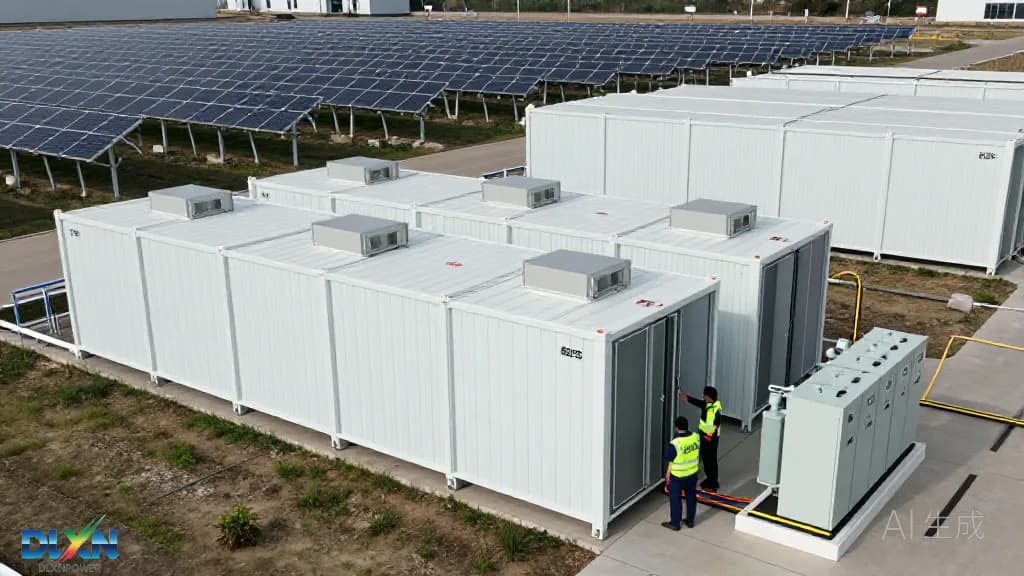
Market Momentum: Storage Becomes Mainstream Infrastructure
Battery storage is no longer a niche adjunct to solar. According to the IEA's Batteries and Secure Energy Transitions work and its 2025 investment reporting, batteries accounted for roughly 90% of all new energy storage capacity added worldwide, with annual grid-scale additions exceeding 40 GW. BloombergNEF's storage outlook projects cumulative installations surpassing 400 GW / 1,100 GWh by 2030, driven increasingly by commercial and industrial deployments behind the meter rather than utility procurement alone.
The commercial segment is growing for a structural reason: economics. BloombergNEF's battery price survey recorded turnkey four-hour system prices falling below USD 200/kWh in major markets during 2024, with Chinese-manufactured DC blocks trading far lower and US projects carrying tariff and domestic-content premiums. Simultaneously, the levelized cost of storage (LCOS) for high-utilization commercial applications — demand-charge management, peak shaving, TOU arbitrage — has fallen into ranges that deliver paybacks of four to seven years in markets like California, Texas, Germany and Australia.
Policy is amplifying the trend. The US investment tax credit allows standalone storage to claim a 30% base credit with adders for domestic content and energy communities; FERC Order 2222 opened wholesale markets to aggregated distributed storage; and the EU's Clean Energy Package mandates grid-connection rights for storage. For C&I owners, the practical result is that storage is now evaluated on its own merits, not merely as a solar bolt-on.
LFP Cell Scaling: 314 Ah to 587 Ah and the 5 MWh Container
Lithium iron phosphate (LFP) has effectively won the stationary storage chemistry contest, holding well above 90% of new grid-scale and C&I deployments. The defining 2025 shift is cell capacity. The 280 Ah cell that defined 2022–2023 designs has been superseded by 314 Ah as the mainstream standard, with second-generation products at 587 Ah, 625 Ah and 628 Ah entering volume production. CATL's TENER product, EVE's Mr.Big series and equivalent platforms from Trina, Jinko and Sungrow push a standard 20-foot container to 5–6.9 MWh.
Higher cell capacity reduces part count, busbar joints, and BMS channels per MWh — directly lowering cost and failure points. A 5 MWh container typically specifies 12,000+ cycles at 70–80% state of health, 25–30 year design life, and round-trip efficiency of 88–92% at the DC block level. Warranties have extended accordingly, with many Tier-1 vendors offering 15-year performance guarantees and capacity augmentation schedules rather than outright replacement.
The practical implication for a commercial buyer is that a single 20-foot container now delivers what required two or three containers in 2021, collapsing balance-of-plant, civil works and interconnection costs per kWh. When specifying equipment, insist on cycle-life testing to IEC 62619 and UL 1973, independent third-party capacity verification, and clarity on whether the nameplate MWh figure is at beginning of life at 25°C or already derated. Our [lithium battery product range](/products/lithium-battery) reflects these second-generation LFP parameters.
Chemistry Diversification: Sodium-Ion and LMFP Arrive
LFP's dominance does not mean chemistry innovation has stalled. Sodium-ion batteries reached commercial maturity in 2025, with CATL's Naxtra line (roughly 175 Wh/kg, mass production from December 2025), HiNa and BYD all shipping cells targeted at stationary storage rather than vehicles. Sodium-ion's advantages are structural: abundant raw materials decoupled from lithium and cobalt price volatility, excellent cold-temperature performance down to about −40°C, and superior safety characteristics due to lower energy density and more stable thermal behavior.
The trade-off is energy density and cycle life. Early sodium-ion storage products land in the 100–160 Wh/kg range versus 160–190 Wh/kg for LFP, meaning larger footprints per MWh, and cycle life is generally quoted at 3,000–6,000 cycles rather than 12,000. That makes sodium-ion a strong fit for short-duration, cold-climate or cost-sensitive applications — Nordic commercial sites, telecom backup, and markets where lithium supply risk dominates procurement decisions — rather than a universal LFP replacement.
Lithium manganese iron phosphate (LMFP) represents the incremental path, adding manganese to the LFP lattice to raise voltage from roughly 3.2 V to 3.6–3.7 V and improve energy density by 15–20% without abandoning LFP's safety profile. In 2025 LMFP remains predominantly an EV chemistry, but several storage vendors are sampling it for space-constrained C&I cabinets. Buyers should treat both chemistries as legitimate but verify field data, not datasheet claims.
Cell-to-AC Architecture, 1500 V DC and Liquid Cooling
System architecture has changed as much as chemistry. The 2025 default for commercial systems is a cell-to-AC block: cells, modules, racks, BMS, HV infrastructure, bi-directional PCS and transformer integrated into a single factory-tested enclosure. Sungrow's PowerTitan, Tesla's Megapack, Fluence's Gridstack Pro and comparable platforms ship pre-assembled and pre-commissioned, cutting on-site work from months to weeks and shifting quality control from the construction site to the factory.
DC bus voltage has standardized at 1500 V, with 2000 V architectures under development at major Chinese manufacturers to reduce current, cable cross-section and ohmic losses. Liquid cooling has displaced air cooling in nearly all new C&I and grid-scale products, holding cell temperature differentials within ±2–3°C across the rack. That uniformity is not cosmetic: a 5°C spread can degrade cycle life by 10–20%, so thermal uniformity directly converts into warranty value.
String-level or distributed PCS topologies are gaining share because they eliminate the single point of failure inherent in central inverters and improve part-load efficiency — important for commercial profiles with long low-power periods. When comparing proposals, ask for part-load efficiency curves at 25%, 50% and 75% load, the number of MPPT or DC channels per block, and whether the PCS is capable of four-quadrant operation. More detail is available in our [battery storage technology overview](/tech/battery-storage) and [inverter technology pages](/tech/inverters).
Safety Engineering, Codes and Grid-Forming Capability
Safety has moved from a marketing feature to a regulatory gate. UL 9540A cell-level thermal runaway testing is now effectively mandatory for US deployment, and the fifth edition places greater emphasis on installation-level fire propagation. NFPA 855 and the 2024 International Fire Code impose separation distances, maximum stored energy per fire area, gas detection, deflagration venting and emergency response planning. The January 2025 fire at Vistra's Moss Landing facility underscored that even large, mature sites remain exposed when detection and suppression design lag.
Modern commercial systems respond with multi-layer defense: cell-level pressure and temperature sensors, pack-level aerosol or perfluorohexanone suppression, container-level combustible gas detection with automatic shutdown, and explosion venting sized to NFPA 68/69. Third-party validated hazard mitigation analysis is increasingly required by AHJs and insurers before permits are issued.
On the grid side, IEEE 1547-2018 compliance is table stakes, but 2025 tenders increasingly require grid-forming capability per IEEE 2800-2022: voltage and frequency ride-through, synthetic inertia, fast frequency response and black-start readiness. Grid-forming inverters allow storage to stabilize weak networks rather than merely follow them, revenue in islanded or high-renewable-penetration grids. For commercial microgrids, this capability is what allows a site to ride through a utility outage without a diesel generator.
EMS, Revenue Stacking and the Software Layer
Hardware differentiation is compressing; software now determines returns. A modern energy management system must simultaneously execute demand-charge management, TOU arbitrage, peak shaving, photovoltaic self-consumption maximization and frequency-response bidding, while respecting interconnection limits and degradation budgets. The best platforms use model-predictive control with weather and load forecasting, updating dispatch every few minutes rather than on static schedules.
Interoperability standards matter for avoiding vendor lock-in. Specify IEEE 2030.5 / OpenADR 2.0b for utility demand response, SunSpec Modbus or MQTT for SCADA integration, and open APIs for fleet aggregation. Under FERC Order 2222 and Europe's comparable aggregation frameworks, small commercial systems can be pooled into virtual power plants and bid into wholesale capacity, energy and ancillary service markets, adding revenue streams that can justify 20–40% of project economics in the right jurisdiction.
Degradation-aware dispatch is the emerging frontier: rather than treating the battery as a fixed asset, advanced EMS platforms price each cycle against future capacity value, avoiding aggressive cycling in high-revenue months that would trigger expensive augmentation later. Ask vendors for their state-of-health estimation methodology and whether the warranty is based on measured capacity testing or modeled estimates.
Procurement Guidance and Economics for 2025
Commercial storage economics now hinge on utilization and tariff structure more than capital cost. In California, demand-charge reduction alone can deliver strong returns; in Texas, energy arbitrage and ancillary services dominate; in Germany, peak-shaving and intraday trading drive the model. A well-sized C&I system typically runs 1–4 hours duration, with 2-hour systems dominant where demand charges exceed USD 15/kW-month and 4-hour systems preferred where solar shifting is the primary value.
Cost benchmarks for 2025 place turnkey commercial systems in the USD 300–600/kWh range depending on market, enclosure, interconnection scope and warranty term, with DC blocks significantly cheaper. Buyers should model LCOS over the full contract life including augmentation, not simply compare USD/kWh at installation. Independent engineering review, performance guarantees with liquidated damages, and clear augmentation schedules are the three contractual elements that most reliably protect asset owners.
Finally, integrate storage planning with generation and site infrastructure. Coupling storage with high-efficiency modules from our [solar panel range](/products/solar-panels), or with solar carports such as the [EOS Carport](/eos-carport) for sites with constrained land, improves self-consumption and shortens payback. Detailed engineering support and site assessment are available through our [technical team](/contact).