
What a Traditional Grid-Tie System Actually Does
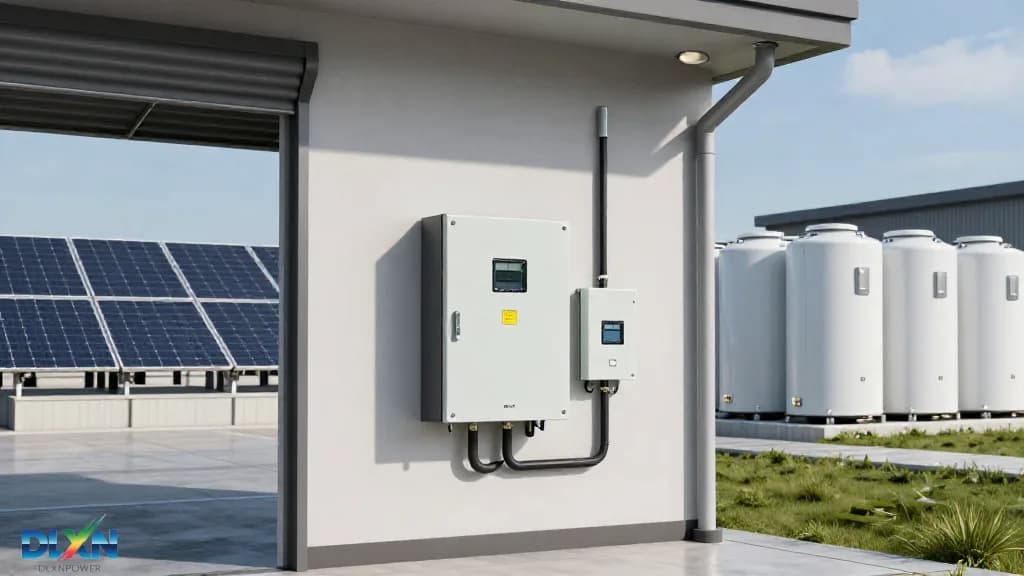
A traditional grid-tie system is the simplest photovoltaic architecture in commercial use: an array of modules, a string or micro-inverter, a AC disconnect, and a bi-directional utility meter. There is no energy storage. All generated DC power is converted to AC and either consumed on site or exported to the distribution network, and at night the building draws entirely from the grid. According to the U.S. Energy Information Administration, the average American household consumes roughly 10,500–11,000 kWh per year, so a typical 7–9 kW residential array covers most annual energy with a modest export surplus.
Its appeal is capital efficiency. NREL's cost benchmark work has repeatedly shown that storage-free residential PV carries the lowest installed cost per watt, and under classic net metering every exported kilowatt-hour is credited at the retail rate — effectively using the grid as a free, infinitely large battery. Efficiency is high because energy is converted once, with no round-trip losses; a modern string inverter reaches 97–98.5% peak efficiency.
The structural weakness is availability. Under IEEE 1547 and UL 1741 requirements, anti-islanding protection forces a grid-tie inverter offline within two seconds of losing the utility source, to protect line workers. The consequence is stark: during a wildfire shutoff, hurricane or ice storm, a fully functional array produces nothing. For sites where outages are rare and short, that trade-off is rational. For sites with unreliable grids or critical loads, it is a hard limit.
How Battery-Backed Grid-Tie Systems Differ Technically
Adding storage changes the topology, not just the bill of materials. A hybrid inverter — for example a unit specified through our [/tech/inverters](/tech/inverters) range — contains an MPPT solar input, a bidirectional battery DC/DC stage, and a grid-interactive AC stage. When the grid fails, it opens the grid relay and forms its own voltage and frequency reference, creating an islanded microgrid for a backed-up load panel. Transfer times of 10–30 ms are now common on UPS-grade hybrid platforms, fast enough that computers and medical equipment ride through unperturbed.
There are two main coupling approaches. DC-coupled designs charge the battery directly from the array through a single inverter, which is more efficient for stored solar and ideal for new builds. AC-coupled designs retrofit a battery inverter onto an existing grid-tie system, preserving the original inverter and simplifying permitting. Consult [/tech/battery-storage](/tech/battery-storage) for architecture trade-offs. Modern hybrid units also comply with UL 1741 SB and IEEE 1547-2018, meaning they can provide voltage/frequency ride-through, volt-VAR support and, where permitted, grid-forming functions.
Battery chemistry matters for the comparison. Lithium iron phosphate (LFP) packs typically deliver 6,000+ cycles at 80% depth of discharge with 90–95% DC round-trip efficiency, giving 12–15 years of calendar life in residential duty. System-level AC-to-AC efficiency, including inverter losses and standby consumption, generally lands between 85% and 90% — the physical price of dispatchability that a traditional system never pays.
Cost, Payback and the Battery Economics
BloombergNEF's annual battery price survey recorded lithium-ion pack prices falling to roughly USD 115/kWh in 2024, a ~20% year-on-year drop — the largest decline in years — driven by LFP overcapacity in China. Installed residential storage, however, is a different number: permitting, inverter integration, labor and enclosure push delivered costs to roughly USD 1,000–1,500 per kWh of usable capacity in the U.S., and somewhat less in Germany and Australia. A 10 kWh battery therefore adds USD 10,000–15,000 to a project.
Traditional grid-tie remains the low-cost leader. NREL benchmarks place residential PV at roughly USD 2.5–3.0 per watt DC before incentives, so a 8 kW array is on the order of USD 20,000–24,000. Adding storage can raise project cost 40–70%. Incentives narrow the gap: the U.S. investment tax credit covers 30% of both generation and storage when paired with solar, and many EU member states and Australian states offer additional storage rebates.
Payback now depends less on generation and more on what a kilowatt-hour is worth. Under California's NEM 3.0 net-billing tariff, export compensation dropped to an average of roughly USD 0.05/kWh versus about USD 0.30 previously — a fall of roughly 75%. When exports are nearly worthless, self-consumption becomes the return driver, and stored solar consumed at USD 0.40–0.60/kWh evening rates justifies the battery on economics alone, independent of backup value.
Resilience, Backup Sizing and Real Load Profiles
Backup performance is a sizing problem, not a marketing claim. A typical "critical load" subpanel covering a refrigerator (1.5–2 kWh/day), LED lighting, internet router, sump pump and a gas furnace blower draws only 3–5 kWh per day. A 10 kWh battery with 90% usable capacity can sustain that indefinitely if the array produces even modest output each day. Whole-home backup is a different scale: an all-electric home with heat pump and EV charging may pull 40–80 kWh daily, demanding 30–60 kWh of storage and careful load management.
Continuous power rating matters as much as capacity. A 10 kWh hybrid inverter typically supplies 5–8 kW continuous and 10–12 kW surge for motor starts; a well pump or air-conditioner compressor can momentarily demand 3–5 times running current. Undersizing the inverter leads to nuisance shutdowns, so engineers commonly size the backup inverter to the largest motor plus steady loads rather than to average daily consumption.
Storage also improves daily efficiency in ways a traditional system cannot. Where a grid-tie array exports 40% of production at a low credit and buys it back at night at a high rate, a battery re-routes that energy internally. Round-trip losses of 10–15% are far cheaper than a 3–6× retail-to-export price spread, which is why self-consumption rates above 70% are now the design target in most reformed markets rather than gross generation.
Policy and Tariff Reform Are Changing the Math
Regulatory design has become the single largest variable in the comparison. California's net-billing transition, Australia's declining feed-in tariffs (now often AUD 0.03–0.08/kWh), and Germany's reduced small-system feed-in rate under the EEG all push the same direction: exports are worth little, self-consumption is worth a lot. The IEA's solar PV tracking reports show storage attachment rates climbing sharply wherever export compensation falls, with residential battery attach rates in leading markets moving from roughly 10% in 2021 toward 25–40% by 2024–2025.
Virtual power plants are the emerging counterweight. Aggregated home batteries can bid capacity into wholesale and frequency-response markets; in Australia's NEM and parts of the U.S., VPP payments of AUD 200–600 or USD 300–800 per household per year are documented. This converts a passive asset into a revenue stream, something a traditional grid-tie system cannot access. Several utilities now also offer time-of-use rates with 3–5× evening-to-overnight spreads, monetizable only with storage.
Interconnection rules are tightening in parallel. IEEE 1547-2018 and UL 1741 SB require smart-inverter functions such as specified ride-through and ramp-rate limits, and some jurisdictions impose export limits or "zero-export" conditions on constrained feeders. In those cases a battery is not an upgrade but a prerequisite for adding any capacity at all — the grid-tie-only option is simply refused.
Designing the Right System: Sizing Rules and Equipment Choice
Start with the load, not the hardware. A practical sequence: quantify daily consumption and peak demand, identify critical circuits, then choose PV and storage to meet self-consumption targets. Common residential ratios are 1.2–1.5 kW of PV per kWh of usable battery for high-self-consumption designs, and 0.8–1.2 for backup-led designs with modest daily cycling. Array oversizing (DC:AC ratios of 1.3–1.5) is standard and improves shoulder-season yield without clipping losses.
Equipment selection should favor LFP chemistry for thermal stability and cycle life, hybrid inverters with sub-30 ms transfer and open monitoring APIs, and modules with strong low-light performance. Reviewing [/products/solar-panels](/products/solar-panels) and [/products/lithium-battery](/products/lithium-battery) side by side helps align module degradation curves with battery warranty horizons so both assets age together rather than forcing a mid-life inverter change.
Commissioning quality determines whether the design survives contact with reality. Rapid shutdown compliance under NEC 690.12, correct neutral-ground bonding in islanded mode, load-shed relays for heavy appliances, and firmware configured for the local grid code are all non-negotiable. Documented performance data from delivered installations — see our [/projects](/projects) reference builds — is a better guide than nameplate specifications, because real backup behavior depends on temperature, shading and load diversity.
Common Mistakes and Where the Industry Is Heading
The most frequent error is buying capacity instead of capability. A 20 kWh battery on a 3 kW inverter still cannot start an air conditioner, and a system only for outage duration may cycle too shallowly to capture time-of-use arbitrage on normal days. The second is ignoring standby losses and parasitic loads — a "backed-up" circuit that nobody audited can drain a battery overnight. The third is failing to model tariff changes over a 20–25 year system life, when export compensation is likely to fall further.
The direction of travel is clear: bidirectional, grid-forming, software-orchestrated systems. Vehicle-to-home charging, second-life LFP modules, and AI-driven dispatch that forecasts weather and prices are already in commercial deployment. Traditional grid-tie will not disappear — it remains the correct, lowest-cost answer for cheap-export markets and sites with reliable power — but the default new-build specification in reformed markets increasingly includes storage.
For buyers, the honest framing is a risk decision. A traditional grid-tie array minimizes cost per kilowatt-hour and maximizes simplicity. A battery-backed hybrid maximizes autonomy, tariff resilience and optionality. If the grid is dependable and exports are well paid, save the money. If outages, low export credits or evening price spikes are in play, the battery is not a luxury — it is the part of the system that actually earns its keep.