
Why the Economics of Commercial Storage Flipped
For most of the 2010s, a behind-the-meter battery for a mid-size commercial site was a sustainability gesture with a 10-year or longer payback. That calculus changed on two fronts: cell costs and tariff design. BloombergNEF recorded a 20% drop in lithium-ion pack prices in 2024 alone, and the IEA notes that battery costs have fallen roughly 90% since 2010 on a volume-weighted basis. A 500 kWh commercial system that cost $600,000 in 2018 can now be specified for under $200,000 in many markets.
Tariff structures did the rest. Commercial and industrial customers in deregulated markets increasingly face demand charges of $10 to $25 per kW per month, and in constrained territories such as parts of California, New York and Texas that figure can exceed $30/kW. For a facility with a 500 kW peak, a 20% reduction in billed demand is worth $24,000 to $60,000 annually — before any energy arbitrage or backup value is counted.
Storage also stopped being an accessory to solar and became a standalone asset class. Since the US Inflation Reduction Act made standalone storage eligible for the 30% investment tax credit, projects no longer need to be paired with generation to qualify. That single regulatory change unlocked a wave of C&I deployments that pencil out purely on bill savings.
What "Traditional" Actually Means: Grid-Only and Diesel Backup
The traditional baseline is not one thing. It is a spectrum: pure grid supply with a diesel generator for outages at one end, and a lead-acid UPS room at the other. Both remain common, and both carry costs that rarely appear in the headline capex number.
A diesel genset is cheap to buy — typically $300 to $500 per kW installed for a standby unit — and expensive to run. At a fuel price of $3.50 per gallon and roughly 10 kWh of output per gallon at full load, fuel alone costs about $0.35/kWh. Add maintenance, load-bank testing, fuel polishing and the regulatory burden of EPA Tier 4 Final or EU Stage V emissions compliance, and the effective cost of backup energy climbs well past $0.40/kWh. A generator that runs 200 hours a year for demand response and outages can easily consume $30,000 in fuel and service over a decade.
Lead-acid UPS banks have their own profile. They are inexpensive per kWh of nameplate capacity but are typically discharged only to 50% depth to preserve life, deliver 500 to 1,500 cycles, and need replacement every three to five years in cycling duty. Round-trip efficiency sits around 75% to 85%, compared with 90% to 95% for modern lithium iron phosphate (LFP) systems. Over a 15-year horizon, a lead-acid bank may be replaced three or four times.
Inside a Commercial Battery Storage System: Technical Parameters
A modern C&I system is a stack of well-defined components. The cells are usually LFP, chosen for thermal stability and cycle life of 4,000 to 8,000 cycles at 80% depth of discharge. The battery is managed by a BMS, converted by a bidirectional power conversion system, and orchestrated by an energy management system that reads interval meter data and decides when to charge and discharge. Our overview of [battery storage architecture](/tech/battery-storage) walks through that stack in detail.
Sizing decisions hinge on duration and C-rate. A 250 kW / 500 kWh system runs at 0.5C and delivers two hours of discharge, which is the sweet spot for demand charge management because utility billing peaks are typically measured over 15-minute intervals. A 250 kW / 250 kWh system at 1C suits short, sharp peak shaving and frequency response but offers little arbitrage. Most commercial sites land between one and four hours of duration.
Coupling architecture matters too. DC-coupled designs share a single inverter between solar and battery, avoiding double conversion losses and typically gaining 2 to 4 percentage points of round-trip efficiency. AC-coupled designs retrofit onto existing solar more easily and allow the battery to operate independently of the PV array. The right answer depends on whether you are building new or adding to an existing rooftop system — a decision that also shapes inverter selection, which we cover under [inverter technology](/tech/inverters).
Head-to-Head: Lifecycle Cost, Performance and Risk
The table below compares a traditional diesel-plus-grid model against an LFP storage system on a per-site basis for a 500 kW peak facility. Figures are indicative ranges drawn from publicly available vendor data, NREL cost benchmarks and the Lazard Levelized Cost of Storage analysis.
| Parameter | Diesel Backup + Grid | Lead-Acid UPS | LFP Battery Storage |
|---|---|---|---|
| Installed capex | $150–250k | $80–150k | $150–300k |
| Usable energy cost | n/a (fuel) | $200–400/kWh | $250–450/kWh |
| Round-trip efficiency | 30–40% (fuel) | 75–85% | 90–95% |
| Cycle life | ~15,000 hrs runtime | 500–1,500 | 4,000–8,000 |
| Response time | 8–15 seconds | <10 ms | <100 ms |
| Recurring cost | Fuel + service | Replacement every 3–5 yrs | Minimal O&M |
| Revenue capability | Demand response only | None | Arbitrage, DR, capacity |
The decisive column is the last one. Diesel and lead-acid are pure cost centers. A battery can earn: it arbitrages time-of-use spreads, participates in demand response programs, provides frequency regulation in markets like PJM and ERCOT, and reduces demand charges every month. In markets with capacity payments, a well-sited commercial battery can offset 30% to 60% of its own annualized cost through stacked revenue.
Risk profiles differ as well. Diesel depends on fuel logistics, which fail precisely when the grid fails — during storms and outages. A battery charged from on-site solar is independent of fuel supply chains. IEEE 1547-2018 has also standardized how storage interconnects and rides through grid disturbances, removing much of the early technical uncertainty that made utilities hesitant to approve commercial batteries.
Field Evidence: Case Studies and Measured Returns
Google's Belgium data center became a frequently cited reference point when it deployed a 2.75 MW battery system to replace part of its diesel backup for routine grid events rather than emergencies. The company reported using the battery for daily peak shaving, cutting diesel runtime substantially while maintaining full backup capability. It demonstrated that storage can displace generation rather than merely supplement it.
In the commercial retail and cold storage segments, the pattern repeats. Facilities with high refrigeration loads and sharp morning pull-down peaks see the largest demand charge reductions, often 20% to 40%, because their load profile is predictable and the battery only needs to shave a narrow window. Stem Inc., which operates one of the largest behind-the-meter fleets in North America, has publicly reported that its typical C&I customer achieves double-digit percentage reductions in annual electricity spend.
Australia offers a different data point. Under ARENA-supported commercial trials, businesses combining rooftop solar with storage in high time-of-use tariff zones have reported paybacks in the five to eight year range without subsidies, and shorter where state battery rebates apply. The economics improve markedly when a facility already has a solar array, since the marginal cost of adding storage is lower than a greenfield install. Our [project portfolio](/projects) includes several configurations of this type across commercial and industrial sites.
Sizing, Safety and Interconnection: Where Projects Fail
Most commercial storage projects that die do not die on economics. They die on fire code and interconnection. NFPA 855 in the United States imposes separation distances — commonly three feet from walls and openings — and thresholds at which additional fire suppression, detection and ventilation are required. UL 9540A cell-level thermal runaway testing is now the de facto evidence standard for demonstrating that a system will not propagate a fire between modules.
Interconnection is the second filter. Under California's Rule 21 and comparable regimes such as G99 in the UK, review timelines and technical requirements scale with system size, and fast-track screens have limits that many commercial systems exceed. Engaging the utility early, with a single-line diagram and a completed UL 9540 listing, shortens the queue considerably. Sites with existing service capacity headroom avoid the most expensive upgrade: a transformer replacement can add six figures to a project overnight.
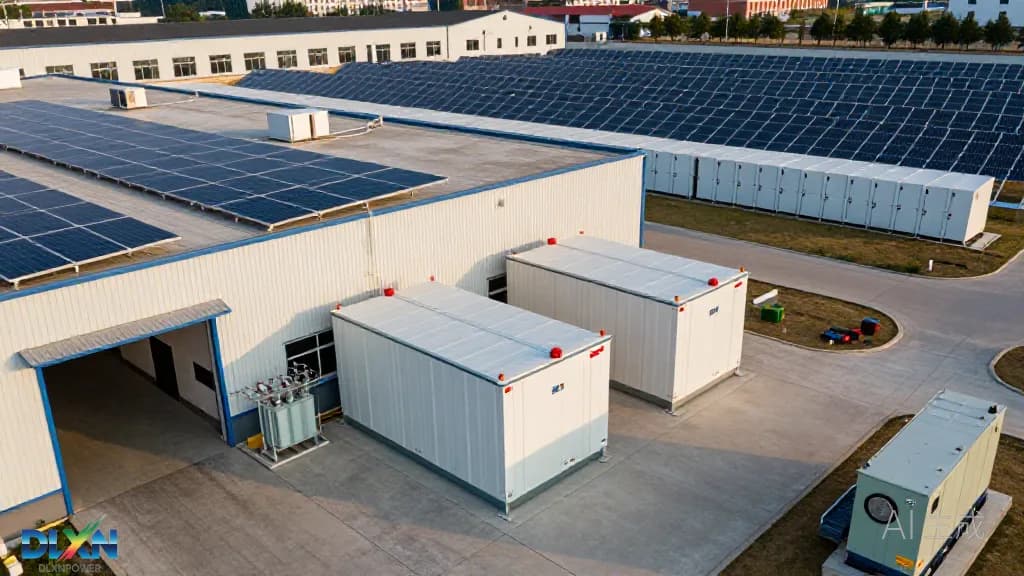
Safety design also drives layout. Containerized systems are typically spaced to prevent cascading failure, and thermal management — whether air-cooled or liquid-cooled — determines both the achievable C-rate and the degradation curve. Liquid-cooled enclosures generally hold cell temperature variation within 3°C, which extends calendar life compared with air-cooled racks that can see 8°C to 10°C spreads across a module.
Financing, Incentives and Choosing a System Partner
The incentive varies sharply by jurisdiction and materially changes payback. In the United States, the 30% investment tax credit applies to standalone storage, with bonus adders of 10% for domestic content and 10% for projects in energy communities. Accelerated MACRS depreciation lets owners write off a large share of the basis in the first year. In the UK, qualifying battery storage has been zero-rated for VAT since February 2024. Victoria, Australia, offers rebates of up to roughly $2,950 for residential and small business batteries, and Germany's KfW programs continue to support commercial storage capex.
Where capital is constrained, third-party ownership structures dominate. Energy-as-a-service agreements and power purchase agreements shift the upfront cost to a financier who monetizes the tax credits and depreciation, while the host site pays a below-retail rate per kWh. These structures reduce the customer's risk but also capture a meaningful share of the upside; for facilities with taxable income and available capital, direct ownership typically produces the highest net present value.
Underwriting discipline matters more than brand selection. A defensible model uses 15-minute interval data for at least 12 months, applies measured degradation of 2% to 3% per year for LFP, and assumes round-trip efficiency of 88% to 92% after auxiliary loads. Vendors offering a 10-year warranty with 70% capacity retention are the current market standard, and anything weaker should be scrutinized. Matching the storage enclosure to the site — rather than defaulting to a catalog unit — is where [our engineering team](/about) typically finds the last 10% to 15% of project value.