Why “Traditional” Almost Always Means Central Inverters
The word “traditional” in inverter procurement is not a vague reference to old electronics; it describes a specific architecture—the central inverter. Since the 1990s, large ground-mount projects have routed thousands of module strings into DC combiner boxes, feeder circuits, and switchgear, all feeding one containerized machine rated from 500 kW to more than 4 MW. These central units offer a proven bill of materials at very low per-watt price, often under $0.03 per watt in recent bids, and their big transformers can handle high short-circuit currents on the grid side.
The limitation of that legacy design is resolution. A central inverter typically sees a handful of maximum power point trackers (MPPTs), representing thousands of modules. Mismatch due to soiling, thermal gradients, tracker setbacks, or panel degradation is averaged across the block and never fully corrected. The industry kept the design because electricity prices were generous and inverter costs were below 5% of installed system capital. Today, as electricity prices have fallen and LCOE calculations have tightened, utilities increasingly compare the traditional central package against distributed string architectures before signing the PPA.
String Inverters: Architecture Designed for Fault Tolerance
A string inverter places power conversion directly next to the DC source. Commercial units range from 20 kW to 350 kW, and a multi-megawatt plant simply creates a row or cabinet of these units—each with 4 to 12 independent MPPTs. Instead of exporting thousands of amps at 600–800 V to a central station, each string bus operates close to the array, using 1,000 V or 1,500 V DC. The reduction in DC cabling and the elimination of combiner boxes lowers energy losses at the source and improves the safety profile of the DC network.
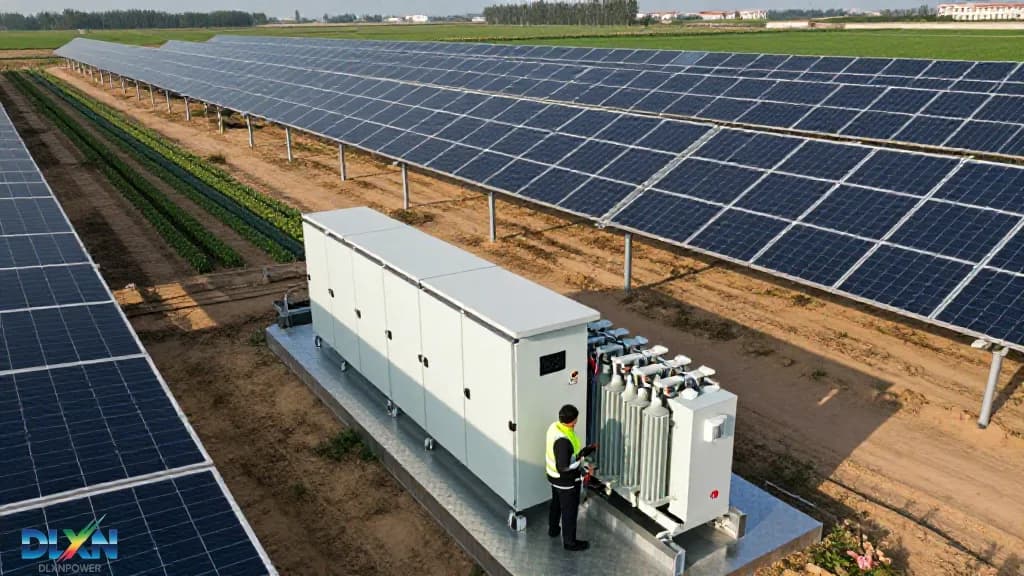
This architecture is sometimes called “semi-central”: dozens of string inverters are clustered in steel shelters next to transformer skids, creating a footprint similar to traditional central stations. The critical difference is granularity. If one string unit fails, the plant loses 1–2% of its nameplate capacity, not 25–50%. According to PV system operators, unplanned downtime is the most significant factor in operations-and-maintenance (O&M) budgets, so utilities have begun specifying string topology even for 100 MW–plus sites. More detail on this topology shift is available on our [inverter technology hub](/tech/inverters).
Efficiency and Yield: Where the Kilowatt-Hours Actually Land
Peak efficiency is no longer a dividing line: modern three-phase string inverters achieve maximum efficiencies of 98.6–99%, very close to modern central stations. The real difference appears in partial-load performance. A photovoltaic array rarely operates at full nameplate power—capacity factors for fixed-tilt systems typically range from 15% to 25%. Low morning light, afternoon clouds, tracker backtracking, and DC/AC ratio designs near 1.3 mean the inverter works most hours at 20–60% of rated load. In that range, advanced string units with silicon-carbide power modules retain more than 97% efficiency, while transformer-based central designs historically struggle to hold their peak rating.
The second structural advantage is the 1,500 V DC revolution. Moving from 1,000 V to 1,500 V reduces current by about one-third for the same power, and conductor losses fall with the square of current—meaning nearly 55% lower I²R losses in the DC wiring. String inverters were the first topology to deploy 1,500 V component-level electronics in volume. Analyses published under the IEA Photovoltaic Power Systems Programme note that lower DC plant losses plus multi-MPPT granularity can recover 1–3% more annual energy than the traditional central design in hilly or variable irradiance sites.
Shading, Mismatch, and the MPPT Advantage
Mismatch losses frustrate every PV engineer. Even on a perfect tracker, module temperatures differ across the field, and a single soiling shower after dusty months can suppress current across entire strings. A traditional central inverter can only regulate its large DC input as a block. If one combiner zone underperforms because of shade from a meteorological mast, fence line, or high-voltage tower, the central MPPT system shifts the operating point for the entire 1–4 MW block, lowering energy capture.
Multiple MPPTs per string inverter solve this problem at string resolution. An operator can connect east-facing, west-facing, and south-facing arrays to a single appliance and let each tracker march independently to its optimum voltage. In a project with module-level power electronics or high-efficiency bifacial panels, the coupling with quality modules determines final gain; you can review panel-level pairings in our [solar panel product catalog](/products/solar-panels). For evenly populated flat fields, the gap narrows, but for irregular sites, compound slopes, and future module replacements, string topology provides a practical hedge against mismatch that traditional machines cannot offer after installation.
Reliability and O&M: Mean Time to Repair in Comparison
Reliability statistics give the central inverter credit: large commercial units are engineered with redundant fans, constant monitoring, and replacement power modules. Their weakness is not failure rate but the blast radius of a failure. NREL’s PV Fleet Performance Initiative has shown that inverter replacement is among the most expensive O&M events in a utility plant’s life, especially when a central machine requires crane operations, factory technicians, and complete generation shutdown for two to four weeks. When one 3 MW central unit fails, the plant can suddenly lose 30% of its revenue at the height of summer.
String inverters shift the calculus. Although their failure rate per unit is naturally higher due to volume production, the mean time to repair is drastically shorter. A failed 100 kW unit can be exchanged by two technicians with hand tools in a few hours, and the neighboring units continue operating during the swap. According to O&M benchmarking reports from Wood Mackenzie, distributed-string plants routinely show availability above 99% after the first year, while traditional central plants must carry large spare-part inventories and carefully scheduled maintenance windows. DC arc-fault protection and NEC 2017 rapid shutdown requirements are also embedded more easily in string designs.
Batteries and Grid Services Turn String Inverters Into Hybrid Hubs
Energy storage has rewritten the inverter specification. Traditional central plants were built as one-way converters: PV to grid, no flexible export. Modern hybrid and storage-ready string inverters support DC or AC coupling, enabling operators to install batteries without replacing the core power-conversion hardware. The benefit is economic. A hybrid string architecture with DC coupling can charge the battery directly from the DC bus, avoiding two conversion steps and capturing several percentage points of round-trip efficiency—directly relevant to our [DC-coupled battery storage portfolio](/tech/battery-storage).
Grid services add another dimension. Current standards such as IEEE 1547-2018 and UL 1741 SB require voltage ride-through, frequency-watt control, and fast reactive-power response. String inverters, with software-defined controls, can provide these ancillary services at the point of connection rather than at a single central machine. For plant owners, that converts an inverter from a passive component into a revenue asset participating in frequency regulation, volt-var optimization, and curtailment management. The flexibility also simplifies renovation projects, where mixing new storage with an old existing top-down plant traditionally required expensive re-engineering.
Market Data and a Roadmap for the Buy Decision
Procurement data confirms that the architecture debate is producing a fast behavioral change. According to BloombergNEF, solar PV added roughly 420 GW of global capacity in 2023, and the inverter segment remains a multi-billion-dollar market each year. In major project tenders, string-inverter blocks now routinely equal or exceed central-inverter volume because their all-in system cost—including combiner boxes, DC wiring, civil shelters, and O&M escrow—has reached parity at the entire-plant level. Many engineering, procurement, and construction (EPC) contractors now prefer string cabinets for phased construction, as generation can begin when the first 25 MW block is energized rather than waiting for a single central station to be fully commissioned.
For an owner selecting a topology, the 2025 rule of thumb is scenario-based: flat sites in high-grid-cost markets with skilled local maintenance may still favor traditional central units; complex terrain, high module mismatch, variable irradiance, or foreseen storage expansion favor string architecture. Our [project reference archive](/projects) shows completed multi-megawatt plants with hybrid solutions that align the inverter choice with specific terrain and tariff conditions. The energy world is no longer choosing between efficiency and reliability—it is choosing between a concentrated risk footprint and a distributed one. As hardware prices converge, distributed thinking is winning, and the “traditional” title is being convincingly transferred. For assistance with inverter specifications, compatibility studies, or ROI comparisons, reach out to the DLXN Energy engineering team through our [contact page](/contact).