What BIPV Is — and Why It Is Not Rooftop PV
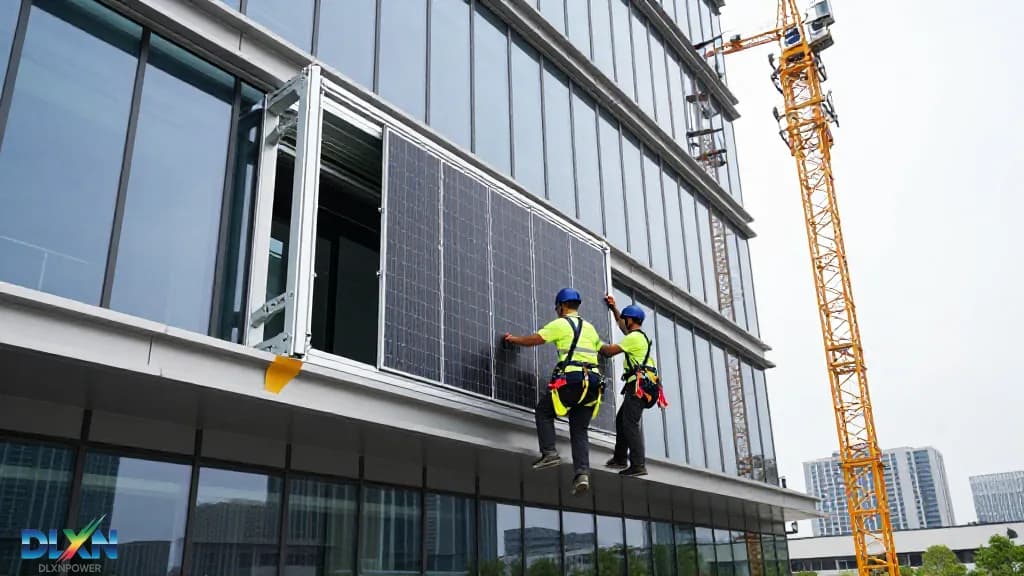
BIPV differs from building-applied PV (BAPV) in one fundamental way: the module is the building envelope. There is no separate roof membrane or cladding sitting behind it, so the product must satisfy two unrelated sets of rules at once. Electrically, modules must meet IEC 61215 for design qualification and IEC 61730 for safety. Structurally and architecturally, they must carry wind uplift, snow load, fire classification, impact resistance and watertightness. Since 2020, IEC 63092-1 and 63092-2 have provided the first dedicated international framework for BIPV modules and systems, and specifiers should now require compliance as a baseline.
The market context explains why BIPV is growing despite complexity. According to IEA PVPS Task 15 — the international research programme dedicated to BIPV — the segment still represents well under 1% of annual global PV additions, even as total installations pass 400 GW per year. BloombergNEF has repeatedly noted that BIPV remains a premium niche driven by regulation and architecture rather than pure cost per watt. The EU's recast Energy Performance of Buildings Directive, which requires solar-ready new public buildings from 2027 and new residential buildings from 2030, is the single largest near-term demand driver outside China.
Feasibility: Structural, Thermal and Shading Assessment
Structural review comes first, because BIPV modules are heavier than the cladding they replace. Glass-glass laminates typically impose 12–25 kg/m² including subframes, compared with 8–12 kg/m² for lightweight metal cladding. On retrofit projects, the engineer must verify remaining capacity against local snow and wind codes — EN 1991-1-3 and EN 1991-1-4 in Europe, ASCE 7 in the United States — and check deflection limits for glazed facades. NREL's analysis of U.S. building stock found roughly 1,118 GW of rooftop technical potential across 8.1 million buildings, but that figure drops sharply once structural and shading constraints are applied.
Solar access modelling is the second gate. Facade BIPV operates at inherently non-optimal angles: a vertical south facade in central Europe receives roughly 60–70% of the irradiance available to a 35° tilted array, with east and west orientations at 50–60%. Use 3D tools such as PVsyst, PV*SOL or Ladybug/Honeybee to model horizon shading, adjacent buildings and self-shading from balcony reveals. Thermal behaviour deserves equal attention: an unventilated BIPV facade can run 20–30 °C above ambient, cutting annual yield by 8–15% versus a ventilated assembly.
Selecting the Right BIPV Product for Each Envelope
BIPV products fall into four practical families. Roof-integrated options include solar shingles and tiles, standing-seam laminates bonded to metal roofing, and large-format glass-glass modules replacing membrane roofing on flat roofs. Facade options include opaque rainscreen panels, semi-transparent vision glazing with 10–50% cell coverage, and solar shading louvers that generate power while reducing cooling load. Bifacial cells are increasingly specified behind glass on light-coloured facades, where rear-side albedo can add 5–15% to output without additional envelope area.
Procurement discipline separates successful projects from stalled ones. Require IEC 63092-1 certification, fire classification to EN 13501-5 (Broof(t1)) or equivalent Class A/B ratings, mechanical load ratings of at least 5,400 Pa, and product warranties of 25–30 years with performance guarantees not exceeding 0.5% annual degradation. Custom dimensions and colours typically push lead times to 12–20 weeks, so order placement must be tied to the construction programme. A qualified supplier such as [our high-efficiency PV module range](/products/solar-panels) can supply the certified product families that satisfy both electrical and envelope requirements in a single BOM.
Electrical Design, String Layout and Power Electronics
String sizing on BIPV is harder than on a ground mount because modules rarely share orientation, tilt or temperature. Calculate maximum system voltage using the record-low ambient temperature for the site — typically −10 °C in temperate Europe, colder in Nordic markets — and verify that Voc at that temperature stays below inverter limits per IEC 62548 and NEC 690.7. Where a single string spans two facades or a roof and wall, mismatch losses of 10–25% are common; segregating orientations onto separate MPPT inputs immediately recovers most of that energy.
Module-level power electronics are close to mandatory on complex envelopes. DC optimizers and microinverters allow per-module MPPT, enable NEC 690.12 rapid shutdown (≤30 V within 30 seconds inside the array boundary under the 2023 NEC), and provide the module-level monitoring that O&M teams need to locate a single failed unit behind cladding. Inverter oversizing ratios of 1.10–1.25 are typical for BIPV because clipping losses are low. Selecting , grid-code-compliant [inverters and DC power conversion equipment](/tech/inverters) at the design stage avoids the costly retrofit of string architecture later.
Mounting, Weatherproofing and Envelope Integration
Subframe design determines both yield and service life. Aluminium rails or a proprietary cassette system should hold modules 40–100 mm off the structural substrate to create a ventilated cavity; measured data shows this gap reduces cell temperature by 10–15 °C on summer afternoons, recovering 4–7% of annual generation. Use stainless steel A2/A4 fasteners, allow thermal expansion joints every 6–8 m of rail run, and ensure every module is individually removable without dismantling adjacent units. Inaccessible modules are the most common BIPV design failure.
Waterproofing follows a two-line defence principle: gaskets and tapes handle the primary seal, while flashings and drainage planes handle anything that gets past them. EPDM gaskets, butyl tape and neutral-cure silicone are the correct materials — acetic-acid-cure silicones corrode module junction boxes and cell metallization. Every penetration for cable conduits must be flashed and sloped, and cable routes should never sit in standing water. For carport and canopy BIPV, where envelopes are exposed on all faces, prefabricated structures such as an [EOS solar carport](/eos-carport) reduce field waterproofing risk by moving critical detailing into the factory.
Commissioning, Monitoring and Performance Verification
Commissioning a BIPV system requires both electrical and envelope verification. Under IEC 62446-1, measure string insulation resistance (≥1 MΩ), continuity of protective earthing, polarity, and open-circuit voltage against expected values. Perform I-V curve tracing on every string and compare against the nameplate under recorded irradiance and module temperature. Thermographic inspection should be conducted at irradiance above 600 W/m² to detect hot spots, bypass-diode failures and interconnect defects; electroluminescence imaging, where accessible, reveals microcracks introduced during handling.
Monitoring closes the loop. Expect performance ratios of 75–85% for BIPV systems, compared with 80–90% for well-ventilated racked arrays, because of higher operating temperatures and non-optimal orientation. Module-level monitoring lets operators distinguish soiling losses — typically 2–5% annually and higher on shallow-pitch roofs — from genuine component faults. Combined with on-site [battery storage](/tech/battery-storage), BIPV generation can be shifted to evening peaks, improving self-consumption ratios above 70% in commercial buildings and strengthening the investment case beyond simple export tariffs.
Costs, Incentives and Real-World Benchmarks
BIPV capital costs remain higher than conventional PV, but the comparison must be made net of avoided envelope materials. Installed facade BIPV typically ranges from €200–500/m², versus €80–150/m² for conventional rainscreen cladding; roof-integrated BIPV runs €150–300/m². Subtracting the cladding cost that would have been spent anyway, the effective premium for the PV function is often €80–200/m², translating into payback periods of 8–15 years depending on electricity price and local incentives. In the United States, the Inflation Reduction Act's 30% investment tax credit runs through 2032 and can be stacked with domestic content bonuses.
Installed projects demonstrate what mature execution looks like. Copenhagen International School's facade carries roughly 12,000 BIPV panels across 6,048 m² of envelope, generating approximately 300 MWh per year while replacing the entire cladding system. Powerhouse Brattørkaia in Trondheim, Norway, combines around 3,000 m² of roof and facade PV with storage, producing roughly 500,000 kWh annually — more than the building consumes. Reviewing documented [completed installations](/projects) before finalizing a specification is one of the fastest ways to de-risk a BIPV design.
Common Pitfalls and a Practical Installation Checklist
The most expensive BIPV mistake happens before installation: engaging the PV engineer after the facade design is frozen. At that point, module dimensions, subframe depths, cable routes and waterproofing details are already fixed, and every change becomes a variation order. Other recurring failures include no maintenance access to junction boxes, no spare modules ordered for the 25-year operating life, missing surge protection on long facade strings, and inadequate lightning risk assessment for buildings over 20 m.
A disciplined checklist keeps projects on track: (1) complete the structural and solar access study first; (2) confirm IEC 63092 and fire certification for every product; (3) finalize module layout with the architect before tender; (4) design strings per orientation with module-level electronics; (5) detail ventilation and two-line waterproofing; (6) order 2–3% spare modules; (7) commission with I-V tracing and thermography; (8) contract O&M with module-level monitoring from day one.