What "Hybrid" Means in 2025
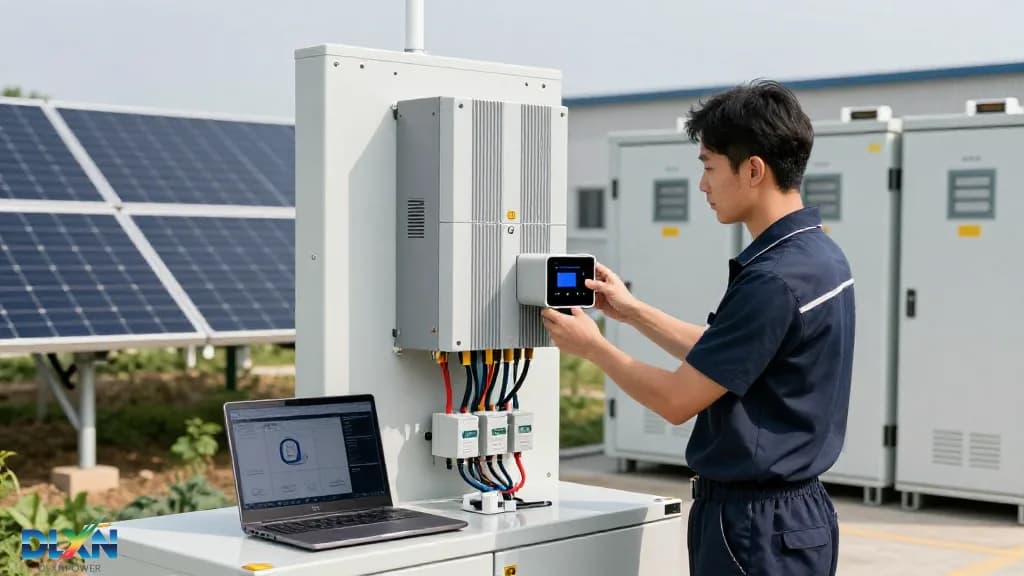
A hybrid solar power system in 2025 is no longer simply a PV array with a backup battery. It is a multi-source, multi-directional energy node coordinating solar generation, a high-voltage battery, the grid, an optional generator, and increasingly an EV charger or heat pump — all managed behind a single intelligent inverter. The defining shift is architectural: hybrid inverters now ship with two to four MPPT channels, a 400 V battery bus and grid-interactive firmware rather than a simple transfer switch. According to the IEA, distributed PV and storage are increasingly sold as one bundled product across mature markets.
Two topologies dominate. In DC-coupled designs, PV and battery share a single DC bus, so solar charges the battery without an inverter round trip; round-trip efficiency typically reaches 90–94%, and the system can run off-grid using one conversion stage. AC-coupled systems retrofit existing string inverters and add a separate battery inverter — simpler to install but losing 2–4% in conversion losses. In 2025 the DC-coupled approach has won the residential market: Tesla Powerwall 3, Huawei FusionSolar and Sungrow's hybrid families all integrate PV MPPTs directly into the battery unit.
Power Electronics: SiC, Multi-MPPT and 98% Conversion
Silicon carbide (SiC) MOSFETs have moved from premium products to mainstream hybrid inverters. Switching at 50–100 kHz instead of 16–20 kHz allows smaller magnetics, chassis that are 30–40% lighter, and peak conversion efficiencies of 98.2–98.6% with CEC-weighted efficiency above 97.5%. European three-phase hybrid units in the 8–30 kW class now routinely advertise 200% DC oversizing, letting a 15 kW inverter serve a 30 kWp rooftop and clip only at peak irradiance. Paired with high-current [TOPCon and HJT modules](/products/solar-panels), that oversizing raises specific yield per euro of inverter.
Module currents have risen alongside cell efficiency. Modern 580–620 W modules push Imp beyond 13.5 A and Voc toward 55 V at −10 °C, so hybrid inverters must accept 16–20 A per MPPT input and handle string voltages to 600 V (residential) or 1,000 V (commercial). Advanced MPPT algorithms sweep the full I–V curve every few minutes and apply partial-shading prediction, recovering 5–15% of yield on complex roofs. Rapid shutdown under NEC 690.12, arc-fault detection and integrated DC isolators are now baseline features rather than options.
The 48 V era is ending. Most 2025 platforms use a 100–400 V high-voltage battery bus with an isolated DC-DC converter running at 97–98% efficiency, which halves cable cross-sections and enables 10 kW+ charge and discharge from one unit. Commercial systems are adopting 800–1,500 V DC architectures borrowed from EV powertrains in megawatt-scale hybrid skids. When comparing [hybrid inverters](/tech/inverters), look beyond peak efficiency and examine the weighted efficiency curve between 20% and 60% load, where real systems spend most of the day.
Battery Storage: LFP at Scale, Sodium-Ion at the Door
Lithium iron phosphate (LFP) now accounts for roughly 90% of new stationary storage capacity, and 2025 cells are larger and longer-lived. Mainstream 280 Ah and 314 Ah prismatic cells deliver 6,000–10,000 cycles to 70% state of health, translating to 15–20 years of daily cycling in a residential duty cycle. BloombergNEF's battery price survey recorded a 20% fall in average pack prices during 2024 to roughly USD 115/kWh, and Chinese LFP cell prices have continued toward USD 50–60/kWh in 2025, pushing installed residential storage below USD 400/kWh in several markets. Modular [lithium battery](/products/lithium-battery) stacks now let homeowners start at 10 kWh and expand without replacing the inverter.
Sodium-ion is the most credible new chemistry of 2025. CATL's Naxtra cells, entering mass production in late 2025, offer roughly 175 Wh/kg and retain over 90% capacity at −40 °C — attractive for Nordic, Canadian and high-altitude deployments where LFP charging must be restricted below freezing. Cycle life remains lower than LFP, typically 3,000–5,000 cycles, so sodium-ion initially targets cost-sensitive and cold-climate hybrid systems rather than premium daily-cycling products. It competes on cold performance and raw material independence, not on energy density.
Pack-level integration has matured in parallel. UL 9540 and UL 9540A fire testing, NFPA 855 separation distances, and integrated aerosol or water-mist suppression are baseline requirements rather than premium extras. Cloud-connected BMS platforms stream cell-level voltage and temperature data to fleet operators, enabling early fault detection; vendors report that predictive analytics can flag cell imbalance weeks before measurable capacity loss appears, reducing warranty exposure and unplanned truck rolls.
AI Energy Management, Tariffs and VPPs
Software now determines hybrid system value more than hardware does. Machine-learning forecasting blends satellite irradiance, numerical weather prediction and household consumption patterns to decide each morning whether to charge from solar, hold reserve or export. In markets with retail tariffs — Nord Pool in Scandinavia, Octopus Agile in the UK, Amber Electric in Australia — optimisation algorithms arbitrage wholesale prices hour by hour. Households on these tariffs commonly report 25–40% lower annual energy bills compared with simple self-consumption strategies, according to retailer and aggregator disclosures.
Aggregation is the second lever. FERC Order 2222 in the United States and AEMO's wholesale demand response mechanism in Australia allow aggregated home batteries to bid into capacity and frequency-response markets. Tesla, Sunrun, Amber and Octopus operate fleets of tens of thousands of systems; one 13.5 kWh battery is negligible, but 50 MW of aggregated storage can earn USD 100–300 per kW-year in capacity payments. Interoperability depends on SunSpec Modbus, IEEE 2030.5 and OpenADR 3.0, so confirm a hybrid inverter supports at least one open protocol before purchase.
Grid Codes, Grid-Forming Control and the 2025 Regulatory Shift
Grid codes have tightened considerably. IEEE 1547-2018 requires smart inverter functions — Volt-VAR, Volt-Watt, frequency-watt and ride-through — and UL 1741 SB certification is mandatory for interconnection in most US jurisdictions. Australia's AS/NZS 4777.2:2020 adds export limiting and similar behaviour, while Germany's VDE-AR-N 4105 remains the European benchmark for three-phase hybrid inverters. Buying a hybrid inverter without current grid-code certification in your jurisdiction means it cannot be legally connected, whatever its technical merits on paper.
The more consequential shift is grid-forming control. As inverter-based generation passes 50% of instantaneous demand in South Australia and approaches similar shares in Spain and Ireland, utilities need inverters that synthesise voltage and frequency rather than follow them. NREL and US Department of Energy programmes have demonstrated grid-forming battery inverters providing synthetic inertia and black-start capability. Several 2025 hybrid platforms now offer a grid-forming mode, though it is typically restricted to backup operation rather than parallel grid-tied service.
Regulation is also reshaping system economics. Germany's Solarspitzengesetz, in force since early 2025, removes feed-in payments during negative-price hours and tightens remote-controllability requirements for new rooftop systems, steering households toward storage and tariff optimisation. The Netherlands is phasing out net metering from 2027, and California's NEM 3.0 has already pushed battery attach rates above 60% for new residential installations. In all three markets, hybrid architecture has shifted from optional to economically rational.
Deployments, Market Data and the 2026 Outlook
Scale is now the story. The IEA's Renewables 2024 report counted roughly 600 GW of new renewable capacity in 2024, about 80% of it solar PV, and projects continued growth through 2030 with distributed PV and storage increasingly bundled. BloombergNEF's energy storage outlook anticipates global annual installations approaching 90 GW / 250 GWh in 2025, up from approximately 69 GW / 170 GWh in 2024. Hybrid systems capture a growing share because they ease interconnection constraints and reduce required grid-import capacity.
Deployment patterns vary by region. Australia passed four million rooftop PV installations in 2025, and federal and state battery rebates have lifted storage attach rates sharply. Ukraine recorded unprecedented residential solar-plus-storage adoption in 2024–2025 as grid attacks made backup essential. In sub-Saharan Africa, hybrid PV-diesel-battery plants cut diesel consumption by 60–80% at mines and telecom sites. Commercial projects increasingly pair generation with EV charging — integrated [solar carport](/eos-carport) formats are being specified for corporate campuses, retail car parks and logistics hubs.
Looking to 2026, three developments matter. Larger prismatic cells of 500 Ah and above will cut cost per kWh further in commercial hybrids. Bidirectional EV charging under ISO 15118-20 will turn vehicles into 60–100 kWh rolling batteries, and hybrid inverters are already adding V2H ports. Sodium-ion will begin competing on price rather than novelty. For buyers, the practical advice is stable: specify open protocols, verified grid-code compliance and a battery platform with a documented expansion path. Reviewing proven configurations in our [project portfolio](/projects) is a sensible starting point before finalising a design.