The 2025 Market Inflection: Storage Becomes a Core Business Asset
According to BloombergNEF's annual battery price survey published in December 2024, average lithium-ion pack prices fell roughly 20% year-on-year to $115/kWh — the steepest single-year decline since 2017. For commercial buyers, that deflation has translated into turnkey four-hour behind-the-meter BESS pricing of roughly $180–$280/kWh in mature markets, depending on interconnection and enclosure costs. The IEA reports that battery storage accounted for more than 90% of all new energy storage capacity added worldwide in 2023, and that grid-scale and commercial installations have continued to grow at double-digit rates through 2024 and 2025.
Three converging forces explain why 2025 is the year commercial storage moved from pilot project to standard capital expenditure. First, capex has fallen faster than tariff structures have flattened, so the spread between off-peak charging and on-peak discharge has widened in absolute terms. Second, demand charges in the US commercial segment routinely run $12–$25 per kW per month, making peak shaving economically compelling even without solar. Third, the US Investment Tax Credit now covers standalone storage at 30% through 2033 under the Inflation Reduction Act, with 10% adders available for domestic content and energy communities.
Regulatory reform has reinforced the trend. FERC Order 2222 requires wholesale markets in the United States to open participation to distributed energy resource aggregations, allowing a single commercial battery to earn capacity, energy and ancillary services revenue alongside bill savings. In Europe, the 2024 electricity market design reform obliges member states to remove double charges on storage and to establish explicit flexibility procurement. BloombergNEF estimates that global energy storage additions will exceed 100 GW of annual deployment before 2030, with commercial and industrial systems representing one of the fastest-growing sub-segments.
Cell Chemistry: LFP Dominance and the Sodium-Ion Arrival
Lithium iron phosphate (LFP) now exceeds 80% of new stationary storage capacity globally, having effectively displaced nickel-manganese-cobalt chemistries in this application. The current commercial workhorse is the 314 Ah prismatic LFP cell, offering roughly 160–180 Wh/kg at cell level and rated for 6,000–8,000 full cycles at 80% depth of discharge, with some tier-one vendors warranting 10,000 cycles under controlled 0.5C cycling. That cycle life translates to a 20–25 year float life at one cycle per day, which comfortably exceeds the 10–15 year design life of most commercial solar arrays.
The headline chemistry development of 2025 is the arrival of sodium-ion in mass production. CATL's Naxtra sodium-ion battery, announced in April 2025 with mass production targeted from December 2025, delivers 175 Wh/kg and retains usable capacity at temperatures down to −40°C, while eliminating lithium, cobalt and nickel from the bill of materials. For cold-climate commercial sites — warehouses in the Nordics, cold storage facilities, telecom huts — sodium-ion removes the need for active heating, which typically consumes 3–8% of a LFP system's stored energy in winter.
Buyers evaluating [lithium battery](/products/lithium-battery) options should also track the EU Battery Regulation 2023/1542, which phases in carbon footprint declarations from 2025 and a mandatory digital battery passport from February 2027. Vendors that can document cell provenance, recycled cobalt content and manufacturing emissions will have a measurable procurement advantage as corporate ESG reporting tightens. Second-life repurposing is also maturing: automotive packs retired at 70–80% state of health are now being redeployed in low-cycling commercial buffer applications.
System Architecture: 1500 V DC, Liquid Cooling and String-Level Control
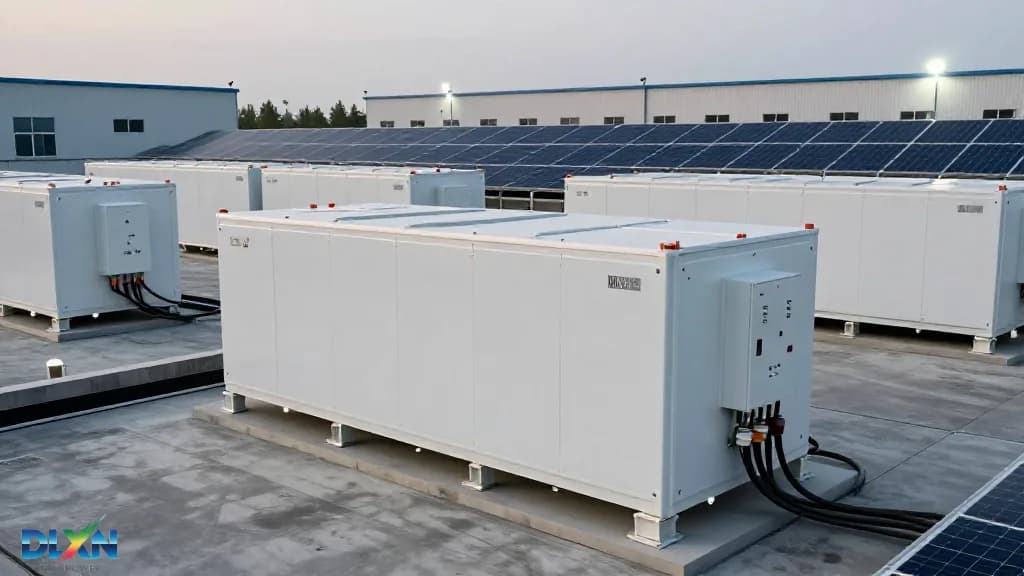
Container architecture has consolidated rapidly. The 2025 reference class is a 20-foot, 5–6.25 MWh liquid-cooled DC block: CATL's TENER ships at 6.25 MWh with a claimed five-year zero-degradation warranty, Sungrow's PowerTitan 2.0 at 5 MWh with hybrid cooling, and Tesla's Megapack 2 XL at 3.9 MWh. All operate on 1500 V DC bus architecture, which reduces resistive losses and conductor cross-section by roughly 30% compared with legacy 1000 V designs. Liquid cooling holds cell-to-cell temperature delta below 3°C, which independent testing consistently links to 15–20% longer calendar life than air-cooled equivalents.
Coupling topology matters more than many buyers expect. AC-coupled systems retrofit easily onto existing PV and simplify interconnection, but incur two conversion steps. DC-coupled designs route solar through a single hybrid inverter, capturing an additional 2–4% round-trip efficiency and allowing clipped solar energy to be captured rather than lost. Modern commercial [hybrid inverters](/tech/inverters) now reach 97.5–98.5% peak efficiency with four to six MPPT channels, integrated rapid shutdown and 200% DC oversizing ratios that make them well-suited to constrained rooftops.
At the module level, string-level MPPT and per-rack DC/DC conversion have replaced centralized architectures in most new commercial designs. The benefit is availability: a single failed rack or module no longer degrades the whole array, and maintenance can be performed without taking the site offline. Round-trip efficiency for a well-designed 2025 commercial system lands between 87% and 92% AC-to-AC, and procurement contracts increasingly specify a guaranteed efficiency floor with financial penalties for underperformance.
The Software Layer: Forecasting, Demand Charge Management and VPPs
Hardware gets the headlines, but the energy management system (EMS) now determines 30–50% of realized project value. Leading platforms apply machine-learning load forecasting with day-ahead accuracy of 90–95% and 15-minute-ahead accuracy above 97%, using weather feeds, historical interval data and production schedules. That precision is what makes demand charge management viable: an unoptimized battery chasing peaks reactively may shave only 15% of a site's monthly peak, while a forecast-driven strategy reliably captures 30–50%, which is the difference between a six-year and a four-year payback.
Modern [battery storage systems](/tech/battery-storage) are also increasingly multi-revenue assets rather than single-purpose backup. A 1 MW / 4 MWh commercial system in an ISO with open aggregation can stack time-of-use arbitrage ($80–$120/kW-year), demand charge reduction ($100–$200/kW-year) and ancillary services such as frequency regulation ($50–$100/kW-year). Under FERC Order 2222, aggregators bundle hundreds of such sites into virtual power plants; Tesla's and Sunrun's residential VPP fleets in California and Texas have demonstrated the model at scale, and commercial portfolios are following in ERCOT, PJM and Australia's NEM.
Openness of the software stack is now a procurement criterion in its own right. Systems that expose Modbus TCP, SunSpec, OpenADR 2.0b and a documented REST API allow third-party optimization, tariff switching and future VPP enrollment without vendor lock-in. Cybersecurity hardening to IEC 62443 and NIST IR 8259 baselines is increasingly required by insurers and by corporate IT security reviews before a battery is permitted on the corporate network.
Safety and Compliance: UL 9540A, NFPA 855 and the EU Battery Regulation
Safety standards have matured into a clear global baseline. UL 9540A testing now measures thermal runaway propagation at cell, module, unit and installation level; a container that passes unit-level testing without propagation can qualify for reduced separation distances under NFPA 855, the US installation standard. The 2023 edition of NFPA 855 sets maximum stored energy per unit, requires gas detection, deflagration prevention or ventilation, and mandates fire suppression sized to the tested failure mode. IEC 62619 and IEC 62933-5-2 provide the parallel international framework, with UL 9540 covering the complete system.
Practical design details separate a compliant installation from a merely certified one. Explosion venting panels, combustible gas detectors calibrated for hydrogen and carbon monoxide, and emergency response plans filed with the local fire authority are now standard deliverables. Standoff distance from occupied buildings and from property lines frequently determines the achievable energy density on constrained industrial sites, which is why procurement teams should model layout before ordering containers.
On the regulatory side, the EU Battery Regulation introduces carbon footprint declarations, due diligence obligations on raw materials, and the battery passport requirement from February 2027. In the United States, insurance underwriters are increasingly requesting UL 9540A unit-level reports and third-party commissioning data as a condition of coverage. Taken together, these requirements mean that the compliance dossier is now as important as the datasheet in vendor selection.
Real-World Deployments and Payback Benchmarks
Representative 2025 economics are converging across markets. A 500 kW / 2 MWh system at a cold-storage facility in California's SCE territory, cycling once daily on a TOU tariff with demand charge management, typically delivers $180,000–$260,000 in annual bill savings against an installed cost near $600,000–$700,000 after the 30% ITC — a simple payback of four to five years. A comparable German industrial site on a 2 MWh system achieves a similar range through peak shaving and intraday arbitrage on the EPEX spot market. Detailed case studies are available in our [completed projects](/projects) portfolio.
NREL's Annual Technology Baseline continues to show behind-the-meter storage costs declining faster than utility-scale equivalents, driven by modularity and shorter installation cycles. Where capital is constrained, energy-as-a-service structures — a third party owns the asset and sells dispatched capacity under a 10–15 year agreement — shift storage from a capital expense to an operating line item, typically at a 10–20% discount to projected utility savings.
Integration with on-site generation multiplies the return at campuses and logistics hubs. Pairing storage with a solar canopy, such as the [Eos solar carport](/eos-carport), lets a facility charge from its own generation during peak production windows and discharge into the evening peak, effectively converting a midday surplus into an evening premium. For sites with EV fleets, the same battery can buffer depot charging loads and defer expensive service upgrades.
What to Specify in 2025: A Procurement Checklist
A 2025 specification should go beyond nameplate capacity. Require a warranted throughput — typically 6,000 cycles or a stated MWh throughput with a 70% end-of-life capacity floor — rather than a simple calendar warranty. Demand a guaranteed AC-to-AC round-trip efficiency, verified by an independent capacity and efficiency test at commissioning, and secure written augmentation pricing so that future capacity top-ups are not priced at spot market rates.
Insist on an open EMS with documented API access, a cybersecurity architecture aligned to IEC 62443, and a firmware support commitment of at least ten years. Verify UL 9540A unit-level test reports, confirm NFPA 855 or local code separation distances against your actual site layout, and request the supplier's spare-parts and field-service footprint within your region.
Finally, model the revenue stack before signing. A system designed purely for backup power may run fewer than 30 cycles per year and never repay its capital cost, while the same hardware for daily arbitrage and demand management will cycle 250–350 times annually. The technology in 2025 is mature; the returns now depend almost entirely on how intelligently the asset is specified and dispatched.