Why Commercial Solar Storage Pays Back Now
The economics of behind-the-meter storage for commercial and industrial (C&I) sites have shifted decisively. According to BloombergNEF's annual battery price survey, average lithium-ion pack prices fell to roughly USD 115/kWh in 2024, a decline of about 20% year on year and the largest drop since 2017. Turnkey commercial systems — including inverter, enclosure, controls and installation — typically land between USD 300 and USD 450/kWh, which is the number that actually matters for a project pro forma.
Demand is following the cost curve. The IEA's renewables market reports show battery storage additions growing faster than any other flexible resource, with global grid-scale and behind-the-meter capacity needing to reach roughly 1,500 GW by 2030 in net-zero scenarios. For a business, the value stack is rarely about energy arbitrage alone; it is peak demand charge reduction, time-of-use shifting, capacity or flexibility market revenue, and resilience against grid outages.
Consider a mid-size manufacturing site with a 500 kW peak and a 2,000 kWh daily consumption. In markets with demand charges of USD 15–25/kW-month, clipping 150 kW off the monthly peak is worth USD 27,000–45,000 per year before any energy arbitrage. That single line item often justifies a 250 kW/500 kWh system on its own. Add a 400 kW rooftop array from our [solar panel range](/products/solar-panels) and the battery begins absorbing midday export that would otherwise be curtailed or sold at low wholesale rates.
Sizing the Battery to Your Load Profile
Sizing starts with 12 months of interval data, not with a rule of thumb. Request 15-minute or 5-minute meter data and separate the load into baseload, weather-sensitive HVAC, and process-driven spikes. NREL's behind-the-meter storage analyses consistently show that peak-shaving value is concentrated in a handful of peak events per month, so a battery sized to the top 10% of intervals captures most of the demand-charge benefit at a fraction of the capital cost of full-peak coverage.
The practical ratio for C&I peak shaving is a battery power rating of 25–40% of site peak demand, with 2–4 hours of duration. A 500 kW site therefore targets 150–200 kW of inverter capacity and 300–600 kWh of usable energy. Depth of discharge matters: lithium iron phosphate (LFP) systems are usually specified to 80–90% usable depth, so nameplate capacity should be divided by that factor plus a 5% end-of-life buffer to get the deliverable energy at year 10.
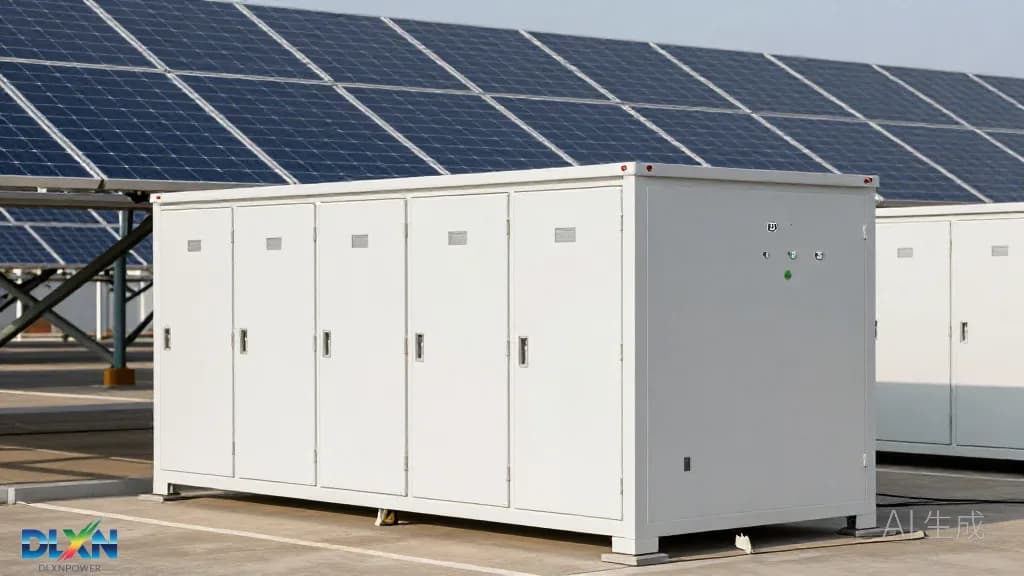
Then layer the solar. Match array output to the battery's charge acceptance and to the building's daytime load. A common commercial configuration is a 100–200 kW PV array with a 100 kW/215 kWh battery, giving a DC:AC ratio near 1.2 and enough storage to shift the evening load block. If your site has EV charging or a staff car park, canopy-mounted generation changes the math — our [EOS carport](/eos-carport) integrates PV, EV charging and battery interfaces in a single structural footprint, which simplifies both civil works and the interconnection application.
Choosing Chemistry and Inverter Architecture
LFP now dominates the C&I segment for good reason: 6,000–8,000 cycles at 80% depth of discharge, superior thermal stability, and no cobalt or nickel exposure. NMC chemistries retain an energy-density advantage for space-constrained plant rooms, but for stationary commercial applications the cycle-life and safety advantages of LFP are difficult to argue against. Our [lithium battery systems](/products/lithium-battery) are specified with LFP cells, integrated HVAC and aerosol fire suppression, and a battery management system reporting at cell level via Modbus TCP or SunSpec.
Inverter architecture is the second major decision. DC-coupled systems route PV through a hybrid inverter into the battery, capturing clipping losses and avoiding double conversion — typically 2–4 percentage points better round-trip efficiency. AC-coupled retrofits are simpler where an existing PV array and grid-tied inverter are already installed, since the battery becomes a parallel AC asset with its own bidirectional converter. Most commercial retrofits choose AC coupling for exactly this reason; new-build projects usually go DC-coupled.
Round-trip efficiency is the parameter that quietly eats your business case. A well-designed LFP system delivers 88–92% AC-to-AC round-trip efficiency when new, degrading to 85–88% by year 10. If your arbitrage spread is USD 0.12/kWh and you cycle 400 kWh per day, a 5-point efficiency difference is worth roughly USD 875 per year — small per unit, but it compounds across a 15-year asset life. Our [battery storage technology overview](/tech/battery-storage) details how topology, thermal management and C-rate selection interact to set that number.
Grid Codes, Permitting and Interconnection
Interconnection is where commercial storage projects most often lose schedule. In the United States, IEEE 1547-2018 governs DER interconnection and requires smart inverter functions — voltage-ride-through, frequency-watt, volt-VAR — that must be enabled and witnessed at commissioning. In Europe, EN 50549-1 and national grid codes impose comparable requirements, and in Germany VDE-AR-N 4105 applies to systems below 135 kW. Design the inverter specification to the applicable standard before you order hardware; retrofitting compliance is expensive.
Fire and building code compliance is equally non-negotiable. UL 9540 certifies the energy storage system as a whole, while UL 9540A provides the cell-level thermal runaway test data that authorities having jurisdiction use to set separation distances under NFPA 855. In practice this means a 500 kWh LFP cabinet may require 900 mm side clearance and 3 m from lot lines and combustibles, depending on the unit's test results and whether suppression is installed. Bring the AHJ into the design review early — pre-application meetings routinely save four to eight weeks.
Permitting also touches structural and electrical scope. Roof-mounted batteries add point loads that may exceed the original design margin, and DC cabling from a rooftop array must be routed with rapid shutdown compliance in mind. Keep a single-line diagram and a load calculation stamped and ready; most jurisdictions will ask for both, plus a fire department access plan showing apparatus turning radii.
Installation, Commissioning and Safety
Physical installation follows a predictable sequence: civil pad or plant-room preparation, conduit and cable tray, DC and AC cabling, battery cabinet setting, then inverter and switchgear termination. Commercial cabinets in the 200–500 kWh class typically weigh 2,000–4,000 kg and require forklift or crane access with a firm, level surface — confirm floor loading and door widths before delivery day. Maintain 1 m working clearance in front of all equipment per NEC 110.26 or the local equivalent.
Commissioning should be witnessed and documented against a written test script: insulation resistance, ground continuity, polarity, torque verification on all terminations, BMS communications, and a full charge-discharge cycle to confirm measured capacity against nameplate within ±5%. Verify that the inverter's grid-protection settings match the interconnection agreement, and record the ride-through and anti-islanding test results — these are the documents that utilities and insurers ask for after an incident.
Safety culture matters more than the datasheet. LFP is thermally , but a 1,000 V DC arc flash is not. Require arc-rated PPE, lockout-tagout procedures, and a documented emergency response plan that includes the fire service. NFPA 855 and IEC 62933-5-2 both call for hazard mitigation analysis; for a commercial site, that analysis should be a living document updated whenever the system's operating envelope changes.
Financial Modelling, Incentives and ROI
Build the model in three layers: avoided cost, new revenue, and incentives. Avoided cost includes demand-charge reduction, time-of-use arbitrage, and avoided export curtailment. New revenue may include capacity market payments, frequency response, or demand-response programme participation — markets such as ERCOT, PJM and National Grid's UK balancing services all accept aggregated behind-the-meter batteries. Incentives are the third layer and vary sharply by jurisdiction.
In the United States, the Inflation Reduction Act made standalone storage eligible for a 30% investment tax credit under Section 48, with adders for domestic content and energy-community siting that can push the effective credit above 40%. In the UK, battery storage installed alongside solar has benefited from a VAT exemption since 2022. Germany's KfW 442 programme offers low-interest loans and repayment grants for commercial storage, and Australia's state schemes in Victoria and South Australia provide comparable support. Stack these correctly — the ITC basis generally excludes grant-funded portions.
Model degradation honestly. A typical commercial LFP warranty guarantees 70% of nameplate capacity at year 10 or 6,000 cycles, whichever comes first. Running the pro forma at 80% average capacity over the asset life rather than 100% avoids the classic overstatement that sinks board approval. With realistic assumptions, most well-sited C&I solar-plus-storage projects in high-demand-charge markets return simple paybacks of 4–7 years, and our [completed project portfolio](/projects) shows the range across manufacturing, logistics and retail sites.
Operations, Maintenance and Warranty Management
A commercial battery system is a low-maintenance but not maintenance-free asset. Expect quarterly visual inspections, semi-annual thermal imaging of terminations, annual capacity tests, and continuous monitoring of cell voltage spread and temperature deltas. HVAC filters and condensers in the thermal management system need servicing annually; a cabinet running 5°C hot will lose cycle life faster than the warranty table suggests.
Data is the real maintenance tool. Set alarms on state-of-health decline greater than 2% per year, cell imbalance above 50 mV, and round-trip efficiency drops beyond the commissioning baseline. Remote diagnostics through the BMS and inverter telemetry let a service partner resolve most faults without a site visit — a meaningful cost difference over a 15-year life.
Finally, keep the warranty chain intact. Cycle counts, depth of discharge and operating temperature windows are all conditions of most commercial storage warranties, and a single season of aggressive cycling to capture a short-term arbitrage spike can void coverage. Document operating history, retain commissioning records, and review the warranty annually against actual dispatch strategy. For specification support on a specific site, our engineering team can review load data and produce a sized configuration — start with a conversation through our [contact page](/contact).