
Factory & Quality — Baoding Manufacturing Base
How DLXN solar modules and LiFePO4 battery cabinets are built, tested, packed and shipped from Baoding, Hebei.
This page documents what happens between a purchase order and a loaded container leaving Baoding, Hebei. It is written for people who audit suppliers: engineers who want the test sequence, procurement teams who want to know which legal entity signs the contract, and inspectors who want to locate the plant before they book a flight.
Everything below describes one facility — the Baoding plant in Hebei Province — because that is where DLXN solar modules and lithium battery cabinets are actually assembled. Rather than a marketing summary, we publish the entity structure, the test flow, the packing standard and the after-sales arrangement, so that a due-diligence checklist can be answered line by line.
1. Production entity vs export entity
Manufactured by our production entity Dongliang at the Baoding facility; exported by Baoding Donglan New Energy Co., Ltd.
Two companies appear in a DLXN transaction, and buyers are right to ask why. The plant that physically builds the modules and battery cabinets is operated by Dongliang, our production entity. The company that signs the export contract, issues the documents and carries the warranty is Baoding Donglan New Energy Co., Ltd. — 保定东岚新能源有限公司. Both are managed by the same team on the same site, and both operate under one quality management system, but they are separate legal persons with separate registrations.
In practice this means a buyer searching the contract counterparty finds Donglan, while a buyer visiting the factory meets Dongliang. Neither name is a trading alias for the other. If your compliance team runs a supplier check, run it on both: ask for the business licence of each, confirm the customs registration number printed on the export documents matches the seller named in the contract, and check that the address on the licence is the address you are auditing.
| Question | Answer |
|---|---|
| Who builds the product | Dongliang — production entity, Baoding facility |
| Who signs the sales contract | Baoding Donglan New Energy Co., Ltd. |
| Who issues invoice, packing list and certificate of origin | Baoding Donglan New Energy Co., Ltd. |
| Whose name is on the warranty certificate | Baoding Donglan New Energy Co., Ltd. |
| Who hosts a factory audit | Dongliang production management, with Donglan export staff present |
Why structure it this way? Exporting requires an entity holding the foreign trade operator registration, customs consignor registration and foreign exchange account, while manufacturing sits with the plant that owns the lines, the test equipment and the workforce. Separating the two keeps the manufacturing entity focused on production and the export entity focused on contracts, logistics and after-sales. For the buyer the split changes nothing about who is liable: your contract, your invoice and your warranty all name Baoding Donglan New Energy Co., Ltd., and the factory behind them is the Baoding plant described on this page.
2. Testing flow: cell sorting, assembly, electrical test, ageing
Every battery cabinet follows the same four-stage sequence, and no stage can be skipped by scheduling pressure. The flow below applies to residential wall-mount and floor-standing packs as well as to the GC100/GC120 outdoor cabinets.
- 1
Cell sorting
Incoming LiFePO4 cells are graded before they touch a pack line. Capacity, internal resistance, open-circuit voltage and self-discharge are measured, and cells are binned so that every series string is built from cells of matched capacity and resistance. A pack built from mismatched cells will drift at the top of charge no matter how good the BMS is, so this is the step that determines how the pack behaves in year five. Each cell carries a barcode that is bound to the pack serial number in our production record.
- 2
Pack assembly
Matched cells are stacked into the designed compression fixture, busbars are laser-welded, and voltage-sense and temperature harnesses are routed and secured. Torque on every mechanical joint is set with a calibrated tool, and the BMS is mounted and its harness continuity checked before the pack goes to the test bench.
- 3
Capacity, insulation and communication test
Each pack and each finished cabinet runs a full charge/discharge cycle to record real capacity against nameplate. Insulation resistance and dielectric withstand tests confirm the isolation between the high-voltage circuit and the enclosure. Communication is tested against the inverter protocols that will be used in the field — CAN and RS485 — including the alarm and protection frames, not only the normal operating frames.
- 4
Ageing
Finished units go onto an ageing rack where they complete charge and discharge cycles under load and then rest while cell voltages are logged. A pack that is going to reveal a weak cell or a BMS fault usually does so here rather than in the customer’s plant room. Ageing data is stored against the serial number, which is what our after-sales team reads when a unit is reported years later.
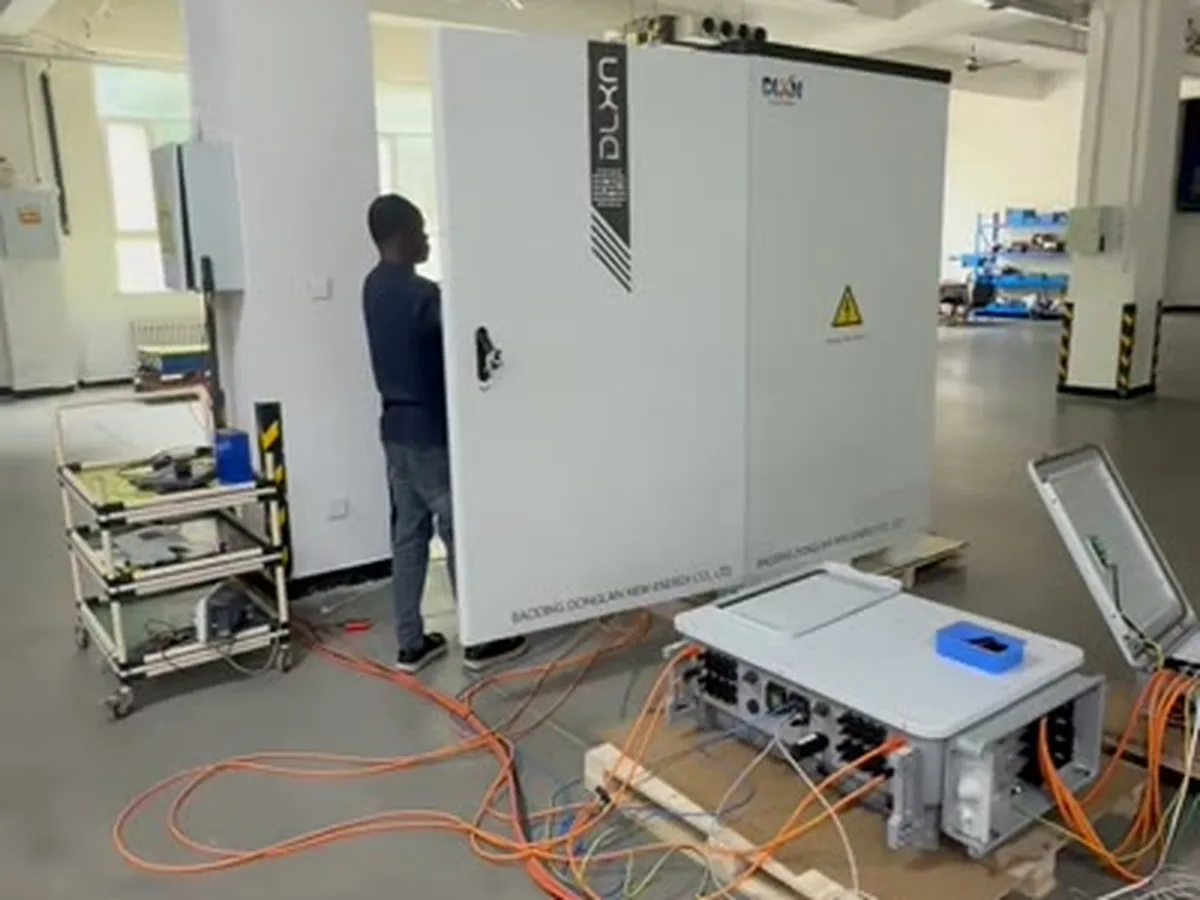
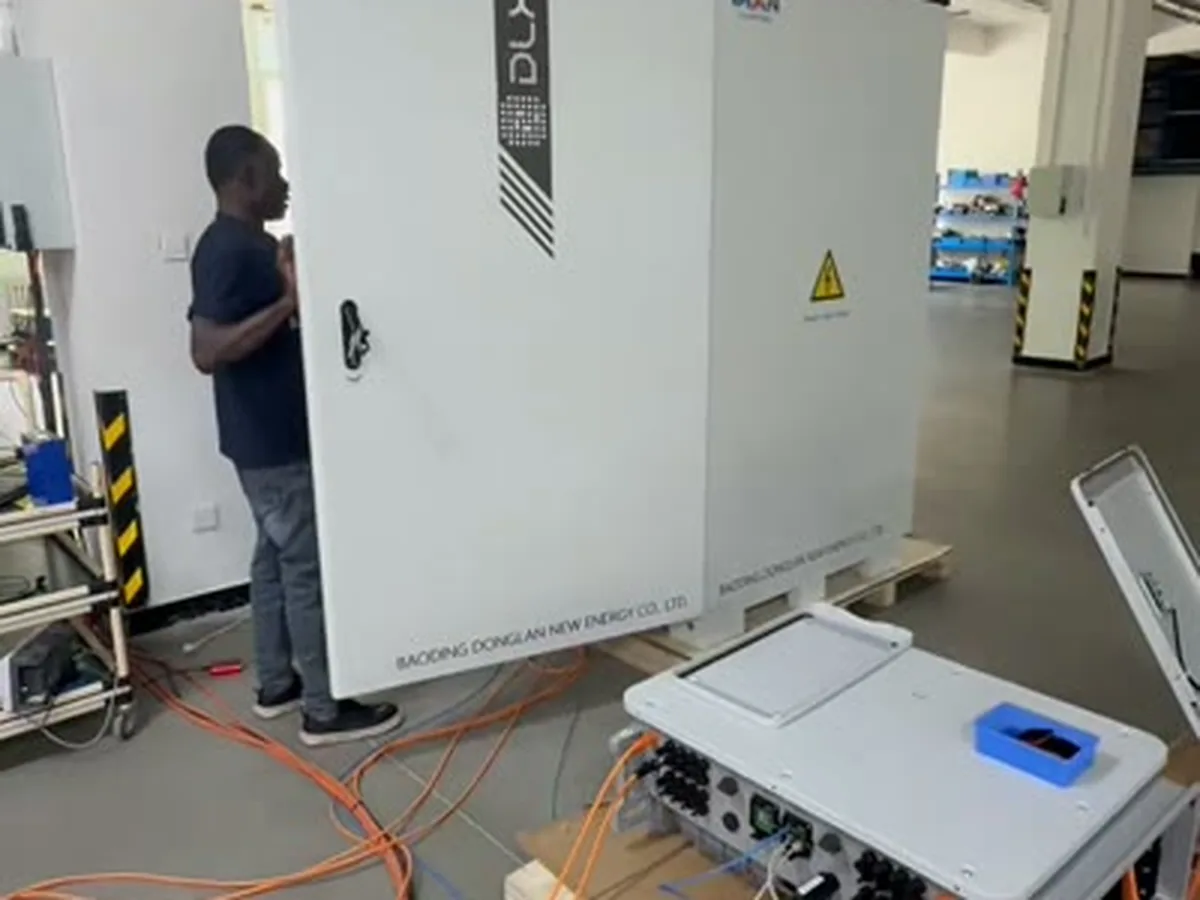
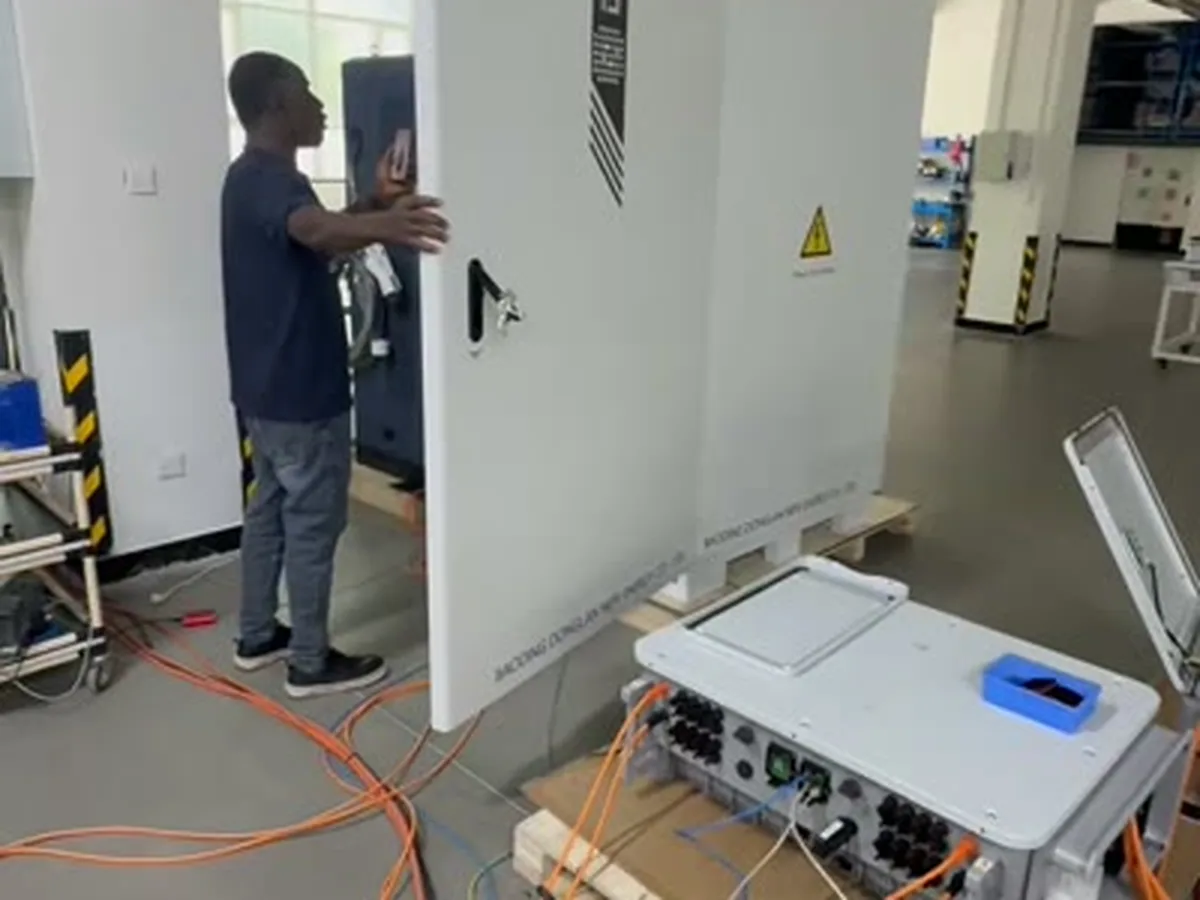
Battery cabinets go through one additional gate that packs do not: a full cabinet commissioning test. Before a GC100 or GC120 leaves the building, the complete system is wired as it will be installed — BMS high-voltage box, contactors, inverter connection, auxiliary supply — and powered up. The fire-suppression interlock is triggered deliberately: smoke and temperature detection must open the contactor, release the aerosol agent, raise the audible and visual alarm in the cabinet and report the event over the communication link. Wiring, terminal torque, labelling and door interlocks are checked at the same time. A cabinet is only released for packing after this test is signed off on the unit’s test sheet, and a copy travels with the shipment.
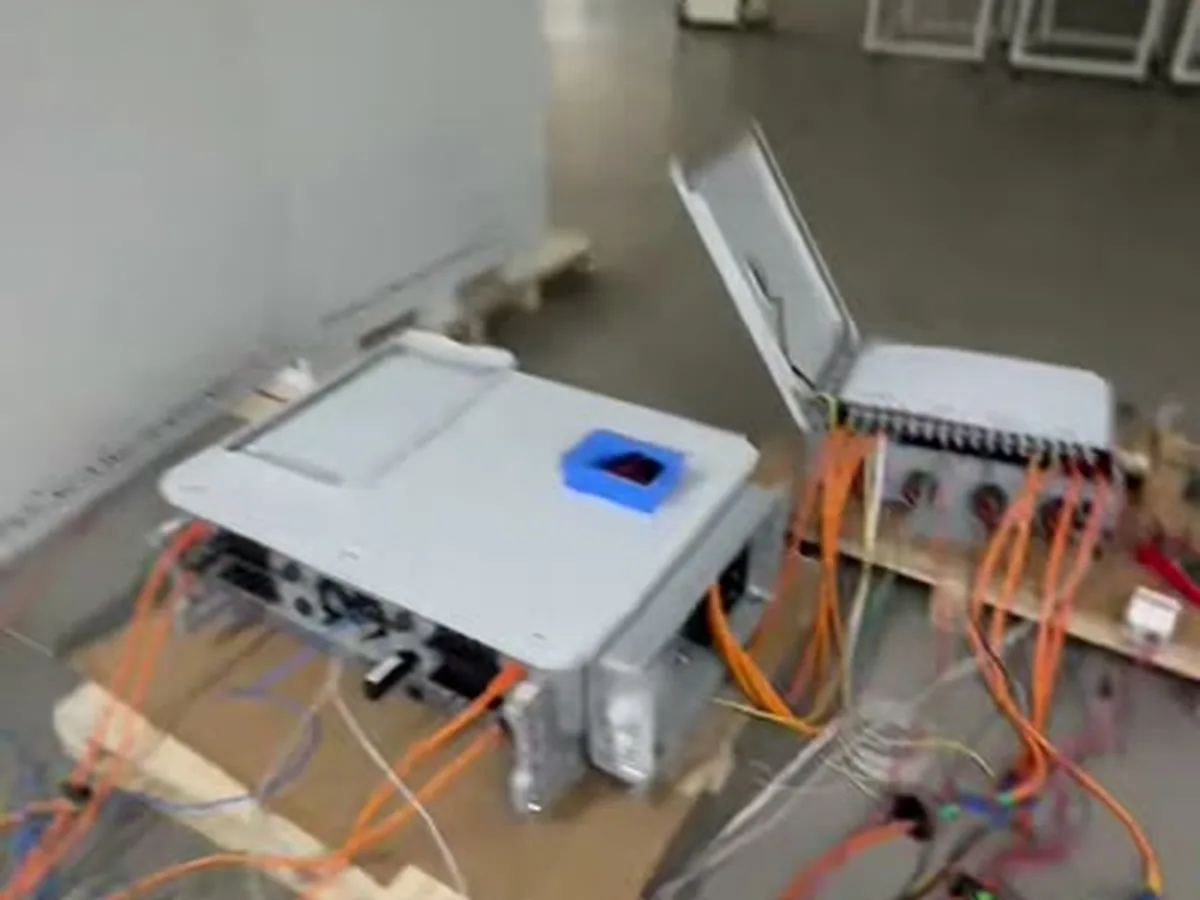
Inside the Baoding plant
3. Packaging and compliance: UN3480, crates and marking
Lithium battery cabinets and packs ship as UN3480, class 9 dangerous goods. Each shipment is prepared with a UN38.3 test summary, an MSDS, and a dangerous goods declaration completed by a trained shipper; cells and packs are transported at a state of charge of 30% or less, which is the condition under which the UN38.3 test data and the air and sea freight rules apply. Cabinets are braced inside the crate so that the pack cannot move against the busbars, and terminals are covered before the enclosure is closed.
Solar modules travel in a different packing logic. Modules are stacked in reinforced cartons on ISPM 15 heat-treated pallets, corner-protected, strapped, and wrapped with a moisture barrier for sea freight. A pallet is loaded so that the frame edges take the load, never the glass. Glass-on-glass and bifacial products get additional edge protection because a hairline crack at the edge is invisible at loading and expensive at destination.
Crating is not cosmetic. Battery cabinets are heavy and top-heavy, so the crate base is dimensioned for the cabinet’s centre of gravity and fitted with skids that allow a forklift to move it without tilting. Crates are reinforced with steel strapping, closed with screws rather than staples so that customs can open and reseal them without damaging the panel, and marked with handling symbols, gross and net weight, dimensions and the UN number. Shock and tilt indicators are applied to the outside of the crate so that both parties can see whether the unit was dropped or laid on its side in transit.
Marking covers the product as well as the box. Every cabinet carries a nameplate with model, serial number, nominal voltage, capacity and manufacturing date, the CE mark where the CE declaration applies, and the standard references used for the battery — IEC 62619 for safety of industrial lithium cells and batteries, UN38.3 for transport, and GB/T 36276 for the stationary application. Modules carry IEC 61215 and IEC 61730 references, the electrical ratings at STC and the serial number that ties the module to its flash-test data. Certification packs, test reports and declarations are issued with the shipping documents so that the importer is not left chasing paperwork after the container has sailed.
Packing, marking and loading (photos being updated)
4. Shipping record by region
The table below lists the regions DLXN ships to on a recurring basis, what typically moves in each direction and how the cargo is normally routed. We do not publish customer names or shipment volumes: those figures are commercially sensitive and, without an auditable source, any number we printed here would be a claim rather than a record. Buyers who need references for their own market can ask for a redacted bill of lading and a customer contact under NDA.
| Region | What ships | Typical routing and terms |
|---|---|---|
| South Africa | Solar modules, residential LiFePO4 packs, C&I battery cabinets | Sea freight to Durban or Cape Town, FOB China or CIF; NRS 097-2-1 documentation supplied for grid connection |
| Nigeria | Solar modules, storage systems, hybrid inverters | Sea freight to Lagos (Apapa / Tin Can), FOB or CIF; NERC and distribution company documents supplied on request |
| Ghana | Solar modules, off-grid and hybrid storage | Sea freight to Tema, FOB or CIF |
| Philippines | Solar modules, residential and C&I storage | Sea freight to Manila, FOB or CIF; ERC and Philippine Distribution Code documents supplied for permitting |
| Middle East | Solar modules, C&I battery cabinets, outdoor ESS | Sea freight to Jebel Ali and other Gulf ports, FOB or CIF; high-temperature derating data supplied with the quotation |
Consolidated shipments from several product lines are loaded at the Baoding plant and trucked to Xingang (Tianjin) or Qingdao for ocean freight. Loading is photographed bay by bay, and the photo set is sent with the shipping documents so that the importer can compare the container condition at destination against the condition at origin.
5. After-sales: warranty, spare parts and remote diagnostics
Battery storage carries a five-year product warranty, with an extended term available on request; solar modules carry a 12-year product warranty and a 25-year linear output warranty. The warranty is issued by Baoding Donglan New Energy Co., Ltd., and the serial number on the nameplate is the key to the claim: it links the unit to its cell batch, its test records and its ageing data. A claim starts with that serial number, not with a description of the fault.
Spare parts are held in Baoding for the models we ship: BMS boards, contactors, fans, communication modules, door seals and replacement packs. The practical question for a buyer is not whether spares exist but how fast they arrive, so we quote the spare-parts list with the original order for projects that cannot tolerate a long outage, and we ship small parts by air courier rather than waiting for the next container.
Remote diagnostics run through DLXN-IOT. Cabinets and hybrid systems that are connected report state of charge, state of health, cell voltage spread, temperature, alarm history and fault codes against the same serial number that appears on the nameplate. When a unit reports an alarm, our engineers read the event log remotely before deciding whether the fix is a firmware setting, a part, or a site visit — which avoids shipping a technician to site to diagnose something the log already shows. The monitoring portal is documented separately, and access can be given to the installer or the end customer.
What we do not do is promise a service level we cannot staff. Response times, spare-part lead times and on-site support are agreed per project in the contract, and for markets where we have no service partner we say so before the order rather than after the failure.
Frequently asked questions
Where is the DLXN factory?+
The DLXN manufacturing facility is in Baoding, Hebei Province, China, in the Baoding High-Tech Zone. Modules and battery cabinets are assembled, tested and packed there, and factory audits and pre-shipment inspections are held at the same site. Contact us before travelling so that the visit is scheduled with production and the export team together.
Can I inspect before shipment?+
Yes. Pre-shipment inspection is welcome, either by your own inspector or by a third-party inspection company. We arrange access to the line, the test records for your serial numbers and the packed goods before the container is sealed, and we photograph loading bay by bay. Book the inspection at least one week before the planned loading date so that the units are still on site.
What certifications ship with the battery?+
Battery cabinets ship with the UN38.3 test summary, MSDS and dangerous goods declaration required for UN3480 transport, together with the IEC 62619 safety test report, the CE declaration where applicable and the GB/T 36276 reference for stationary application. Declaration of conformity, test reports and the packing list are issued with the shipping documents.
What is the MOQ?+
MOQ depends on the product line. Solar modules typically start at one pallet (around 31 panels) and battery cabinets start at one unit, with sample orders possible on request. Full container loads receive the best tier pricing. Send your configuration and destination port for an exact MOQ and FOB quotation.
Book a factory audit or request test records for a specific serial number.
Contact our export team