News & Updates
Latest from DLXN Energy
Commercial Energy Storage Installation: A Field Guide
Read the load profile before you open a battery datasheet
Most commercial storage projects are decided by a spreadsheet and lost in a plant room. The load profile gets one line in the feasibility study, the battery gets three pages of datasheet, and the installation detail arrives after the purchase order. Twelve months later the system cycles at a fraction of its rated throughput, or trips on over-temperature in July, or sits behind an interconnection limit nobody measured. The order of work matters more than the hardware: measure, size, then specify.
Twelve months of 15-minute interval data is the entry ticket. Monthly bills are not a substitute. From that data you need four numbers: the peak kW and when it occurs, the daily kWh swing, the ratio between weekday and weekend load, and how much of the peak is coincident with on-site solar generation. Add the tariff structure on top, because demand charges, time-of-use bands and export limits decide the business case far more than cell chemistry does.
A representative configuration illustrates the point: a 250 kW / 522 kWh AC-coupled system behind the meter at a refrigerated distribution centre in the Netherlands, commissioned in September 2025 and operated by the facility's own maintenance team. The sizing driver was a monthly demand charge and a 1.2 MW transformer that could not be upgraded without a two-year grid queue. Refrigeration load gave a flat, predictable baseline, which is close to ideal for storage. A site with spiky, weather-driven loads would have needed a different power-to-energy ratio entirely.
The duty cycle decides the hardware
Storage cabinets are sold on energy, but they are specified on power. A unit rated for 0.5C continuous discharge delivers its full nameplate energy over two hours; ask the same cabinet for 1C and it either derates, heats up, or both.
| Duty cycle | Typical power-to-energy ratio | Usable duration | Main value stream |
|---|---|---|---|
| Demand-charge peak shaving | 1C to 2C | 30–60 min | Reduced kW billing |
| Time-of-use arbitrage | 0.5C | 2 h | Tariff price spread |
| PV self-consumption | 0.25C to 0.5C | 2–4 h | Avoided import and export clipping |
| Backup / UPS duty | 0.2C to 0.5C | 2–4 h | Outage continuity |
Sites that combine peak shaving with arbitrage often need two different ratings, and the honest answer is usually to oversize power rather than to run the cabinet at its limit every weekday afternoon.
What a datasheet has to state, and what it usually hides
Our own LFP cabinet range runs from roughly 100 kWh to 372 kWh per unit at 1,000–1,500 V DC, with a continuous charge and discharge rating of 0.5C and a cell specification of 6,000 cycles to 80% state of health. Round-trip efficiency sits in the high 80s to low 90s at the cabinet terminals. A 372 kWh cabinet occupies about 1.4 m² of floor and stands a little over 2.2 m tall, which becomes the deciding constraint in a plant room whose service door is 900 mm wide.
Those two figures, footprint and door width, sink more projects than any electrical parameter. Full details of the cabinet range are on the lithium battery product page, and the system-level architecture is described under battery storage technology.
Pay attention to where efficiency is quoted. Terminal-level round-trip efficiency excludes transformer, cabling and HVAC auxiliary losses, and those can remove several further points before the meter sees anything. A system quoted at 92% and measured at 85% is not fraud; it is a boundary condition. Ask for the measurement point in writing.
Where installations break after handover
Thermal design is the first casualty. Cabinets pushed against a wall to save floor space lose their convection path, and the first hot week of the following summer produces derating alarms. NFPA 855, in its 2023 edition, sets separation and suppression requirements that many authorities having jurisdiction now cross-check against UL 9540A cell-level test data, so the fire documentation should be assembled during design, not during inspection.
On our own factory test line, the failures we chase are rarely the cells. They are lugs, torque values and terminal plating, and almost all of them were introduced by the installing crew rather than the production line.
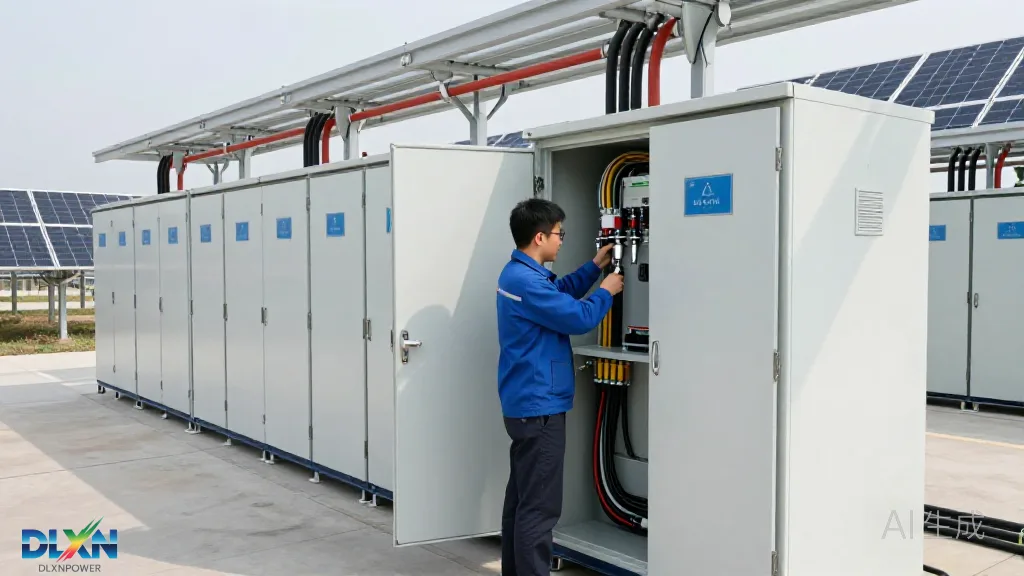
Then there is the mundane electrical work. A storage cabinet added to an existing switchgear lineup changes the fault current, the grounding arrangement and the protection coordination, and none of that is in the battery datasheet. If the site already has rooftop PV, the solar panel range and the storage inverter must be coordinated on export limitation, or the two systems will fight each other at the point of common coupling.
Sites where storage is the wrong purchase
A leased light-industrial unit with a flat energy tariff, no demand charge, and one 40-minute outage in three years does not need a battery. A 20 kVA UPS and a small generator cover the actual risk for a fraction of the capital, and the storage system will never recover its cost through arbitrage alone.
The same applies where the building lease has under five years to run, where the utility will not approve parallel operation, or where lithium cabinets cannot be sited indoors and there is no exterior real estate that satisfies separation distances. In each case the constraint is commercial or regulatory rather than technical, and no amount of engineering effort will move it.
Writing a specification that survives commissioning
- Require 12 months of interval data as a tender attachment, and reject any proposal that does not reference it.
- State the measurement point for round-trip efficiency, cycle life and available energy, with the test standard named.
- Fix the C-rate for each duty cycle separately, and require the vendor to show the derating curve above that rate.
- Include the fire test documentation and the separation distances as deliverable documents, not as post-award clarifications.
- Require a witnessed capacity test at commissioning, with the results recorded against the nameplate figure.
Installation crews that have done this before will ask for the switchgear drawings in week one. Crews that have not will ask for them after the cabinets arrive. Reviewing completed projects gives a sense of what a properly documented handover looks like, and our engineering team can review a load profile before anything is ordered through the contact page.
If the site survey cannot produce interval data, the honest move is to delay the purchase order rather than to size on rules of thumb.
Related products
In-stock models that match this article — specs and RFQ on each page.