News & Updates
Latest from DLXN Energy
LiFePO4 vs Lead-Acid: Residential Storage Compared
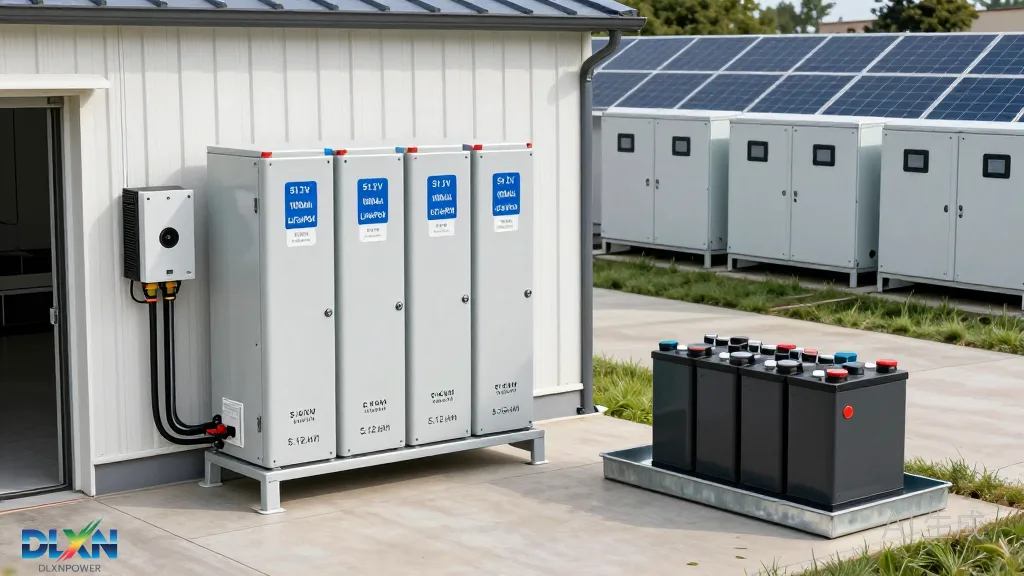
What "traditional" means in a residential basement
Traditional residential storage is lead-acid: flooded cells in a vented box, or sealed AGM and gel monoblocs. It is cheap per nameplate amp-hour, tolerant of crude charging, and familiar to any electrician who has never opened a battery management manual. The catch hides inside the word nameplate. A lead-acid bank should not be cycled below roughly half its rated capacity if you want more than a few hundred cycles out of it, and the Peukert effect means the harder you draw current, the less capacity you actually receive.
So the honest comparison is not 10 kWh against 10 kWh. It is usable kilowatt-hours against usable kilowatt-hours, multiplied by how many times you can spend them.
The numbers that decide it
| Parameter | Flooded / AGM lead-acid | LiFePO4 (DLXN 51.2 V rack module) |
|---|---|---|
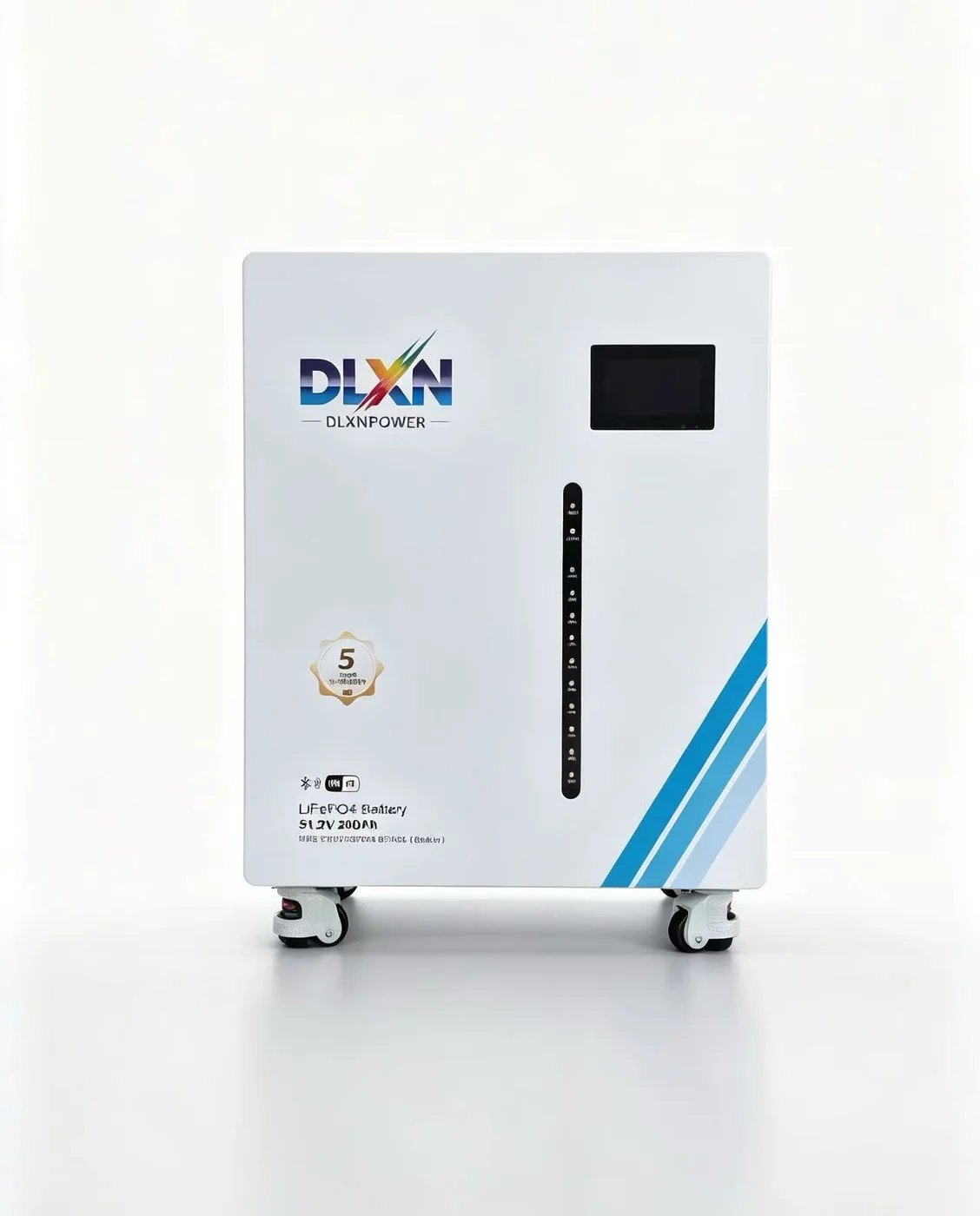
| Module energy | 12 V monoblocs, 100–200 Ah | 5.12 kWh (51.2 V, 100 Ah) |
| Daily usable depth of discharge | 50% (30% for best life) | 90–95% |
| Cycle life to 80% capacity | 300–700 (AGM); up to ~1,200 (tubular gel) | 6,000 at 0.5C, 25 °C |
| Round-trip efficiency | 75–85% | 94–96% |
| Continuous charge / discharge rate | 0.1–0.2C typical | 0.5C (50 A per module) |
| Installed mass per kWh | 25–35 kg | 8–11 kg |
| Routine maintenance | Water topping, equalisation charge | None; BMS-managed |
| Upfront cost per nameplate kWh | Lower | Higher |
Read the first two rows together and the economics shift. Ten kilowatt-hours of AGM gives you five usable, and perhaps 500 cycles of it. One 5.12 kWh DLXN module gives roughly 4.6 kWh usable and, on our test data, 6,000 cycles to 80% state of health. Over a twelve-year horizon a daily-cycled lead-acid bank is usually replaced twice, which is the point at which the lithium premium disappears rather than the point at which it is advertised. Efficiency compounds the gap: a lead-acid system needs meaningfully more PV generation to deliver the same load, because a fifth of the energy is lost in charge and discharge. Cell prices have fallen far enough that BloombergNEF's Global Energy Storage Outlook 2025 treats LFP as the default chemistry for stationary storage rather than a premium option.
Where the chemistry bites: cold, space and current
Lithium iron phosphate has one hard limitation that lead-acid does not. It must not be charged below 0 °C, and every compliant BMS will refuse to accept current until the pack warms. In an unheated garage in a cold climate, that means a sunny winter morning with a full PV array and a battery that will not take the energy. Self-heating modules and heated enclosures solve it, at a cost.
Space and weight favour lithium decisively. A 15 kWh lead-acid bank is a structural object requiring a ventilated room, a spill tray and two people to move a single cell. The same capacity in DLXN rack modules is a wall bracket and a torque wrench.
One retrofit, in detail
A representative configuration we cost regularly: a detached house outside Toowoomba, Queensland, replacing a 24 V flooded bank installed in 2016 with three 5.12 kWh LiFePO4 modules (15.4 kWh nominal) on the garage wall, alongside the existing 6.6 kW rooftop array and a 5 kW hybrid inverter, commissioned in November 2025 and operated by the owner-occupier. The old bank had 390 Ah nameplate, about 4.7 kWh usable when new and considerably less by 2025. The lithium replacement more than tripled usable capacity in a third of the footprint, and the inverter now runs closed-loop over CAN, so state of charge comes from coulomb counting rather than from guessing at a voltage curve. Modules are stackable on a single pair of busbars, which matters when the household adds an electric vehicle in 2028 and wants another 5 kWh without rewiring.
When lithium is the wrong purchase
Buy lead-acid, or buy nothing, if the battery will live in an unheated outbuilding that sits below freezing for weeks at a time and the load cannot tolerate a pack that refuses charge. The second wrong case is the owner with a healthy three-year-old AGM bank and a budget of a few hundred dollars; there is no retrofit that beats using the asset you already own. The third is a household whose actual requirement is ten minutes of ride-through for a router and a boiler controller. That is a small UPS, not a storage system, and a 15 kWh lithium wall is a poor way to buy it.
In our own pack assembly, the field returns we open are almost never failed cells. They are busbar fasteners, terminal torque and BMS harness connectors, and a calibrated torque wrench settles most of them before they ever leave the line.
Wiring, standards and the commissioning checklist
Residential lithium is governed now in a way lead-acid never was. In the United States, NFPA 855 and NEC Article 706 set spacing, signage and disconnection rules; UL 9540A is the thermal runaway test that local authorities increasingly ask to see; AS/NZS 5139 governs Australian installations; IEC 62619 covers industrial lithium cells. None of this is optional paperwork, and it is the main reason a lithium retrofit costs more in labour than the module price suggests. Match the pack voltage to the inverter's DC window before ordering anything, confirm the BMS protocol is on the inverter's supported list, and size the DC breaker to the pack's continuous current rather than its peak.
Our own range and the surrounding electronics are documented at our lithium battery pages and battery storage technical notes; the array sizing usually starts from the panel range and works backwards through hybrid inverter selection.
How to price it this week
Take your daily consumption in kilowatt-hours from a recent utility bill, divide by 0.9, and add one day of autonomy. That number, not the nameplate on the box, is what you are buying. Quote both chemistries against it, ask each supplier for cycle life at a stated depth of discharge and temperature, and ask what the system does on a January morning at −5 °C. If a supplier cannot answer the third question in writing, the proposal is not ready. Sizing help for a specific site is available through our contact form.
Related products
In-stock models that match this article — specs and RFQ on each page.