News & Updates
Latest from DLXN Energy
Commercial Backup Storage Hits 92% Round-Trip Efficiency
Round-Trip Efficiency Becomes the Deciding Metric
Round-trip efficiency (RTE) is the ratio of AC energy delivered out of a battery system to the AC energy put in. Legacy flooded lead-acid systems managed 70–75%. The first commercial lithium racks reached 85%, and for a decade that figure barely moved, because most of the loss sat in power conversion electronics and thermal support loads rather than in the cells themselves. Modern LFP cells are not the bottleneck: their coulombic efficiency exceeds 99.5%, and cell-level DC round-trip efficiency sits at 95–97%, according to data compiled in IEEE power electronics literature.
The commercial significance is straightforward arithmetic. A facility moving 4 MWh through its battery each day loses roughly 40 kWh per day per percentage point of round-trip efficiency. At a blended commercial rate of $0.16/kWh, one efficiency point is worth about $2,300 annually, or close to $20,000 over a ten-year service life before accounting for demand-charge and capacity-tag effects. BloombergNEF's levelised cost of storage modelling reflects the same mechanics: system-level efficiency assumptions drive LCOS more strongly than cell chemistry choice in most C&I use cases.
That is why 2025 datasheets read differently from 2022 versions. Vendors that previously published DC-DC figures now publish AC-AC RTE at defined C-rates and temperature bands, typically 0.5C discharge, 25°C ambient, measured over a full cycle including auxiliary loads. A 90%+ AC-AC claim with those boundary conditions attached is a genuinely different product from an 85% claim measured only across the battery terminals.
Silicon Carbide Pushes Conversion Losses Toward 1%
The most visible driver is the migration from silicon IGBTs to silicon-carbide (SiC) MOSFETs in the inverter and DC-DC stages. SiC devices switch faster with lower conduction and switching losses, and they tolerate higher junction temperatures, which shrinks heatsink mass and reduces the cooling burden inside the power cabinet. Bidirectional SiC inverters now quote 98.5–99% peak efficiency and, critically, hold above 98% across a much wider part-load band than silicon designs did — important because commercial backup systems spend most of their time at 20–60% load, not at rated power.
The second-order benefit matters as much as the headline number. Higher switching frequencies allow smaller magnetics, so a 125 kW bidirectional converter now fits in a cabinet that previously housed 60–75 kW. That density gain lets integrators stack two to three converters plus battery racks in a single footprint, reducing balance-of-system cabling losses between the DC bus and the point of interconnection. According to BloombergNEF's December 2024 battery price survey, average pack prices fell to roughly $115/kWh, with turnkey AC-coupled systems in the $150–$200/kWh band — which means power electronics are now a larger share of total cost, and their efficiency is where incremental value lives.
For buyers, the practical test is the efficiency curve, not the peak figure. Request the measured efficiency-versus-load curve from 10% to 100% load, along with the euro-efficiency or California Energy Commission weighted value. A unit claiming 99% peak but 88% at 20% load is a worse commercial backup asset than a 98.5% peak unit that holds 96% down to quarter load. Our inverter technology overview details how these weighted metrics are calculated and benchmarked.
DC-Coupled Architectures Remove a Conversion Stage
Architecture, not component selection, delivers the largest single efficiency jump. In an AC-coupled retrofit, solar DC power is inverted to AC, then rectified back to DC to charge the battery, then inverted again on discharge — three conversion events, each with its own losses. A DC-coupled design ties the PV strings and the battery to a shared DC bus through a single bidirectional converter, removing one full conversion cycle and typically recovering 2–4 percentage points of system RTE, along with faster backup transition.
The benefit compounds in backup duty. When grid power fails, an AC-coupled system must restart its inverter, synchronise and transfer, a process measured in hundreds of milliseconds to several seconds depending on topology. A DC-coupled architecture with a shared bus and static transfer switch achieves transfer in under 20 ms, well inside the ride-through window of modern IT loads and variable-frequency drives. IEEE 1547 and UL 1741 SB grid-support requirements also favour the DC-coupled approach, because a single controller can arbitrate between solar harvest, battery charge and grid support without conflicting commands from two independent devices.
The trade-off is design complexity, not efficiency. DC-coupled systems require careful string voltage windowing and arc-fault management across combined PV and battery DC circuits. For facilities already running PV, the payback on that complexity is usually under three years; for pure backup retrofits without on-site generation, AC coupling often remains the simpler and cheaper path. Our battery storage technology pages walk through both topologies with single-line diagrams.
Thermal Management: The Hidden Parasitic Load
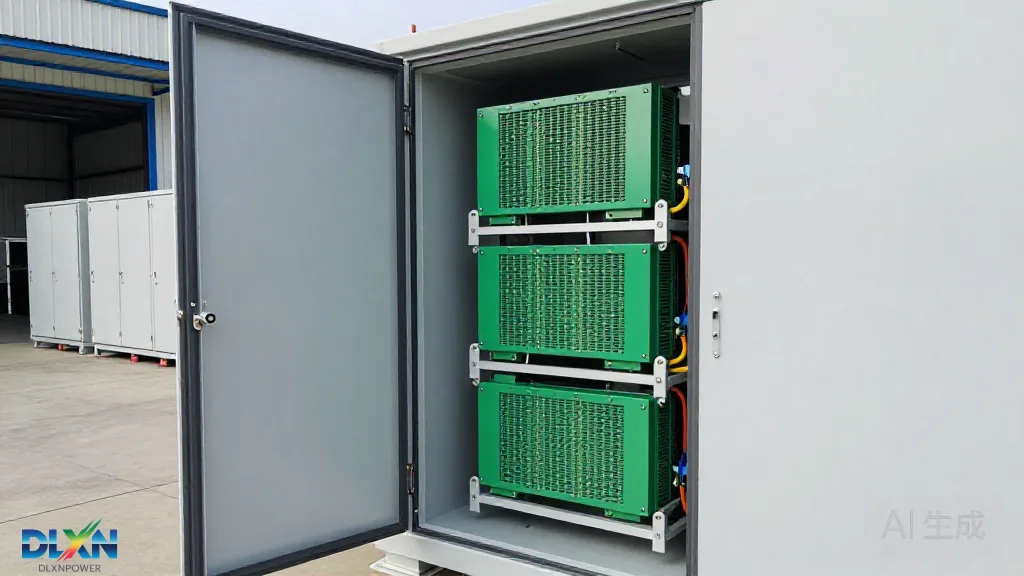
The efficiency figure most vendors omit is the auxiliary load. Air-cooled commercial cabinets run dedicated HVAC units that draw 3–8% of total system throughput in hot climates — energy that never reaches the battery but appears on the facility's meter. In a Texas or Arizona deployment cycling daily, parasitic cooling can quietly erase half the gains achieved in the power electronics.
Liquid immersion cooling has moved from data-centre curiosity to commercial battery product. Immersing LFP modules in dielectric fluid holds cell-to-cell temperature delta under 3°C, versus 8–12°C in air-cooled racks, which slows capacity fade and allows tighter charge acceptance without derating. Vendor field data presented at IEEE conferences indicate immersion reduces cooling parasitic load to roughly 1–2% of throughput while extending projected cycle life toward the 8,000-cycle range at 80% depth of discharge, compared with 6,000 cycles for conventional air-cooled LFP.
Degradation rate is itself an efficiency variable. A system fading at 2% per year delivers measurably less usable energy in year eight than one fading at 1.2%, even at identical nameplate capacity and identical RTE. Buyers should therefore pair efficiency guarantees with degradation curves and augmentation schedules. The lithium battery product line documentation shows how modelled capacity retention interacts with warranty thresholds across a ten-year term.
Verified Deployment Data and Commercial Payback
Field results are now catching up with datasheet claims. Commercial installations in California's SGIP programme and in ERCOT's C&I market are reporting measured AC-AC round-trip efficiencies of 89–91% over full annual cycles, including auxiliary loads, according to programme performance data and project-level monitoring. The gap between a 91% measured figure and the 85% achieved by 2019-vintage systems represents roughly 6% more billable throughput from the same capital outlay.
The economics follow. For a 500 kW / 1,000 kWh system serving a distribution warehouse with a $18/kW demand charge, peak shaving typically captures 100–200 kW of reduction, worth $22,000–$43,000 annually, while arbitrage and efficiency gains add another $8,000–$15,000 depending on tariff structure. NREL's cost modelling puts installed C&I system costs in the $700–$1,100/kWh range for turnkey four-hour configurations, implying simple paybacks of four to seven years in high-demand-charge territories and longer where demand charges are muted. BloombergNEF's LCOS work places four-hour commercial systems in the $140–$200/MWh band, competitive with commercial retail rates in most US markets.
Real projects illustrate the range. A 600 kWh DC-coupled system behind a cold-storage facility in the Central Valley combines PV harvest with demand reduction and outage ride-through for refrigeration loads; a 250 kW/500 kWh installation at a regional hospital prioritises sub-20 ms transfer for imaging equipment. Detailed project case studies document measured performance against modelled performance, which is the only credible efficiency claim in this market.
What to Specify in a 2025 Procurement
The efficiency breakthrough is real but unevenly distributed, and procurement language is where buyers capture or lose it. Four clauses do most of the work. First, define round-trip efficiency as AC-AC at the point of interconnection, measured over a full cycle at 25°C ambient and 0.5C, inclusive of all auxiliary and thermal loads — then attach a contractual minimum with liquidated damages. Second, require the measured part-load efficiency curve and the CEC or euro-weighted value rather than a peak number.
Third, specify an availability floor of 98% and a monitoring data clause granting access to 15-minute interval cell-level and converter-level telemetry, so efficiency can be audited rather than assumed. Fourth, require the degradation curve and augmentation schedule to be stated in usable AC kilowatt-hours at year ten, not DC nameplate. Requests for proposal templates that omit these four items routinely accept systems whose delivered efficiency falls three to five points below the quoted figure.
Integration with on-site generation deserves equal scrutiny. Pairing storage with high-efficiency modules and optimised string design reduces the number of cycles the battery must absorb, extending life. Our solar panel range and integrated mounting platforms such as the Eos carport are commonly specified alongside commercial storage to maximise self-consumption and shrink the required battery capacity. Buyers evaluating a full site design can contact our engineering team for a load-profile assessment ahead of procurement.
Related products
In-stock models that match this article — specs and RFQ on each page.